
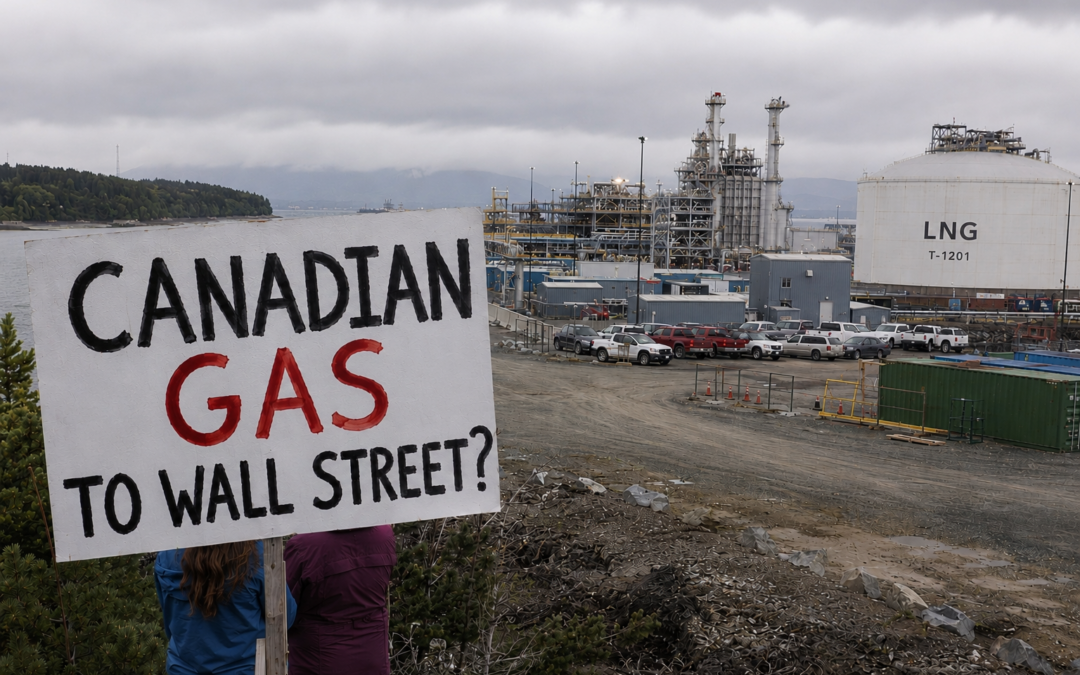
Three American funds are bidding for LNG Canada. One already owns the pipeline that feeds it. Another bankrolls the terminal next door. All three have a Trump insider in their executive suite. Ottawa calls this « nation-building ».
On April 30, 2026, Reuters dropped the news without ceremony: Apollo Global Management, Blackstone, and KKR, three of the largest asset managers on the planet, are the last bidders standing for Shell’s 40 % stake in LNG Canada, the liquefaction megaproject in Kitimat, British Columbia. Deal size: somewhere between 10 and 15 billion US dollars.
The trio is no accident. Each of these firms holds, in its executive ranks, a man close to Donald Trump. Each views North American gas as a strategic commodity to be priced and shipped to Asia. And each is counting on Mark Carney’s government to absorb a piece of the risk.
That is the picture. Three funds, one doctrine, one terminal flaring its gas at 40 times the permitted limit, and a Canadian Prime Minister calling all of it « in the national interest ».
The pipeline is already American
Take KKR first. The New York fund did not show up on virgin ground. Since 2019, it has held a controlling stake in Coastal GasLink, the 670-kilometer pipeline that feeds the Kitimat plant. With its Alberta partner, AIMCo, KKR controls 65% of the project. TC Energy holds the remaining 35 %. The pipe and the terminal end up, downstream, in the same ring of foreign investors.
KKR’s public face for geopolitical matters has a familiar name: David Petraeus. The former CIA director and former commander of US Central Command has chaired the KKR Global Institute, the firm’s strategic-analysis arm, since 2013. Since 2025, he has also run KKR’s Middle East operations. When this fund buys a transcontinental pipeline, it is not a routine stock play. It is a project with a diplomatic dimension. And it has its general.
The terminal next door, funded by Trump’s circle
Eighty kilometers north of Kitimat, on Pearse Island, a second LNG terminal is being assembled: Ksi Lisims LNG. Officially, it is a partnership with the Nisga’a Nation and the Rockies LNG consortium. Unofficially, the plant itself is wholly owned by Western LNG, a Texas-based company funded by the same two firms now circling LNG Canada: Blackstone and Apollo.
At Blackstone, Stephen Schwarzman, who ranks in the top 10 personal donors to Trump’s 2024 campaign, has made a contribution close to 40 million US dollars. At Apollo, Marc Rowan, named by Trump to the Board of Peace, the nine-member body overseeing the reconstruction of Gaza. Rowan sits there alongside Jared Kushner, Marco Rubio, Tony Blair, and Steve Witkoff.
So let us tally. A terminal in the south, about to flip into American hands. A terminal in the north, already in American hands. And a pipeline in between, already in American hands. Three projects, one ring, one doctrine.
The terminal that burns
It gets worse. LNG Canada, the crown jewel of Canadian gas, has a serious mechanical problem. The regulator’s data hammer it home.
According to documents obtained by University of Victoria researcher Laura Minet and reported by CBC News, the terminal emitted roughly 40 times the licensed ceiling on average between October 2025 and January 2026, using its « warm/wet » and « cold/dry » flare systems. December was worse: the regulatory cap was breached by a factor of 60. Flames sometimes reached 90 meters, the height of a 26-story building. The operator itself acknowledges an « integrity issue » with the flare system. Estimated repair: three to five years.
In March 2026, an acid-gas incinerator on one of the two production trains was offline for the entire month. According to regulator data, roughly 10% of the gas piped to the plant in 2025 was burned off. Not exported. Not processed. Burned.
And this is the terminal three Wall Street giants are fighting over. Not for its performance. For its location.
The energy dominance doctrine
The play is not industrial. It is geopolitical.
With ongoing tensions around the Strait of Hormuz, with shipping routes in the Gulf under strain, and with Asian appetite for gas running deep, the Kitimat terminal becomes a strategic chess piece. It is one of the few North American ports offering direct Pacific access without routing through the Panama Canal. Japan, South Korea, India, and Southeast Asia will keep buying gas for decades. Someone will ship. Someone will invoice.
Trump calls this « American energy dominance ». The doctrine is simple: control the sources, control the routes, control the buyers. Gas becomes a commercial weapon, the way oil once did. In this equation, Canada is not a partner. It is a supplier. Worse: a supplier whose subsoil, pipelines, terminals, and soon its shareholders sit under American control.
Canada’s own Energy Minister, Tim Hodgson, said recently from Texas that he was « excited to help America achieve energy dominance ». The line raised eyebrows in Ottawa. It went down well in Houston.
Carney opens the public tap
On November 13, 2025, Prime Minister Mark Carney added Ksi Lisims LNG to the list of « national-interest projects » under the Major Projects Office, established under Bill C-5, the Building Canada Act. LNG Canada’s Phase 2 is on that list, too. The Office’s mandate does not stop at fast-tracking permits. It also coordinates public financing: Canada Infrastructure Bank loans, the Canada Growth Fund, and the Indigenous Loan Guarantee Program.
First concrete move: a 139.5-million-dollar loan from the Canada Infrastructure Bank to BC Hydro to launch the North Coast Transmission Line, the 450-kilometer electricity corridor that will feed, among others, the Ksi Lisims terminal. The gas is private, American, and fast-tracked. The electricity that liquefies it is public, Canadian, and subsidized.
On that score, the Canada Infrastructure Bank confirmed to the Globe and Mail that it has retained an LNG consultant to assess a direct stake in Ksi Lisims. No official decision yet. But the door is more than ajar. It is wide open, with the red carpet rolled out.
And, Western LNG spokesperson Rebecca Scott confirmed to a trade publication that Ottawa’s backing « takes the political risk factor out » for the private financiers Western LNG is still trying to win over. Translated plainly: without public money, the golden goose does not lay.
Private capital hedges, the public pays
Hold on. The story that « private capital is fleeing gas » is too simple. Three funds are fighting over LNG Canada. Asian demand remains strong. Gas is not dead.
But the distinction matters. Private funds want assets that are already built, already fed, already under contract. They do not want to carry construction risk. They do not want to carry regulatory risk. They do not want to carry Indigenous risk, while the Lax Kw’alaams and Metlakatla nations keep challenging Ksi Lisims in court. What they want is a finished terminal, a paid-down pipeline, and a compliant government.
The International Energy Agency confirmed it: in 2025, global investment in clean energy exceeded investment in fossil fuels by a factor of two. The funds rushing to Kitimat are not betting on the transition. They are betting against it. They are betting that states like Canada will keep subsidizing the last act of the fossil-fuel show for a decade or two.
First Nations at the table
Worth stating clearly: Ksi Lisims is not a project imposed against every First Nation involved. The Nisga’a Nation is an official partner and a public defender of the project. To its leaders, this is an instrument of economic sovereignty.
But the arrangement is lopsided. The terminal itself is 100 % owned by the Texas firm. The PRGT pipeline is split fifty-fifty between Western LNG and the Nisga’a government. If the floating terminal sails elsewhere or demand collapses, it is the Nisga’a who will be left with a pipeline and no customers. A « stranded asset » risk that energy economists have flagged for years.
The Council of the Haida Nation and several other coastal Indigenous groups openly oppose the project. The Lax Kw’alaams and Metlakatla’s legal challenge against the environmental assessment is still before the court. The word « reconciliation » gets used by both sides. Not in the same way.
Canada as a strategic commodity
In short, let us spell out cold what is happening.
The single largest energy-export project in Canadian history is on the verge of passing into the hands of three American funds whose principals personally finance Donald Trump, sit on his boards, or lead his geopolitical initiatives. The pipeline that feeds it is already under their control. The neighboring terminal, which will double export capacity, is already theirs. The transmission line that will liquefy the gas will be paid for by taxpayers. And the federal government, through its Energy Minister, is applauding the whole arrangement from Texas.
The flagship terminal, meanwhile, keeps burning gas at four dozen times the rate it is allowed. Three to five years of repairs ahead. Throughout it all, the regulator has issued no stop-work order. The Prime Minister, for his part, just added Phase 2 to the fast-track list.
Canada has positioned itself, in a matter of months, as the missing piece of Trump’s energy dominance doctrine. The subsoil is Canadian. The land is Canadian and Indigenous. The electricity is public. The political risk is carried by Ottawa. The profits, of course, will head to Manhattan.
The gas will flow to Asia. The dividends will flow to Wall Street. The smoke, that one, stays in Kitimat.
And the pigeon, the pigeon signs the cheque.