
Prime Minister Mark Carney’s recent remarks at Davos have crystallized a reality that policymakers and economists have increasingly acknowledged: the United States, long perceived as a pillar of economic stability, is now a growing source of political and economic uncertainty. By openly recognizing this shift on the global stage, Canada has positioned itself as a credible middle power, leveraging its natural resources, institutional stability, and diversified economic structure.
In this context, renewed global interest in Canadian resources, including energy, critical minerals, and strategic infrastructure, could support stronger-than-expected economic performance. However, this momentum is not evenly distributed across the country. Canada’s economic structure remains deeply asymmetric across provinces, inevitably producing both winners and laggards.
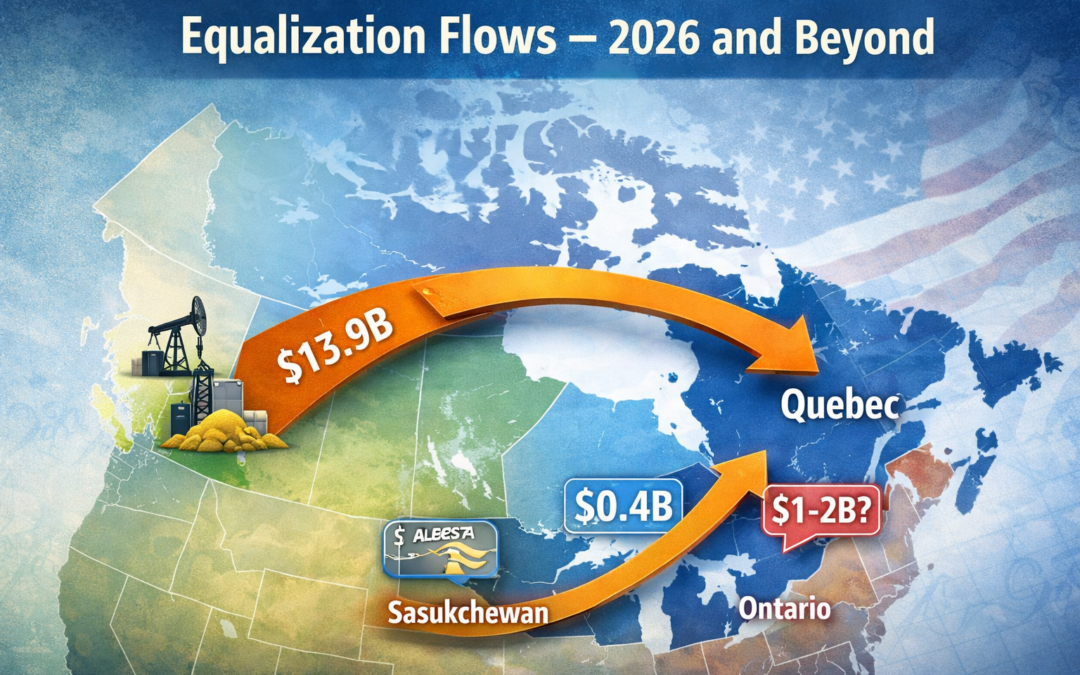
Historically, Quebec has been the dominant beneficiary of the federal equalization program. Yet recent data reveals a more nuanced picture. In 2025–2026, both Quebec ($13.6 billion) and Ontario ($546 million) received equalization payments; however, the scale remains vastly different. This pattern continues into 2026–2027, with Quebec projected to receive $13.9 billion, while Ontario receives $406 million.
At first glance, Ontario’s participation appears marginal. However, this static reading obscures a more dynamic and potentially consequential evolution.
In an environment shaped by asymmetric economic shocks, particularly the potential outperformance of resource-rich provinces and a relative slowdown in Ontario’s manufacturing sector, which remains heavily exposed to U.S. trade, accounting for roughly 75 to 80 percent of Canadian exports, a more pressing question emerges: could Ontario’s equalization payments increase materially in the coming years?
The institutional framework: a rules-based system
Equalization is not a discretionary transfer driven by political negotiations. It is anchored in section 36(2) of the Constitution Act, 1982, which commits the federal government to ensuring that provinces can provide reasonably comparable public services at reasonably comparable levels of taxation.
Payments are determined by a legislated formula based on relative per capita fiscal capacity across five major revenue categories: personal income taxes; corporate income taxes; consumption taxes; property taxes; and natural resource revenues.
Two technical mechanisms are particularly important: a three-year weighted moving average and a time lag of approximately two years. As a result, equalization payments in 2026–2027 reflect economic data from roughly 2022 to 2025.
The program is also constrained by a fixed overall envelope that grows in line with national GDP. This implies that increases in payments to one province must be offset by reductions elsewhere.
A static picture, a dynamic reality
Official projections for 2026–2027 suggest stability. Quebec’s payments increase modestly; Ontario’s remain limited. However, equalization is not a fixed entitlement. It is the outcome of a relative comparison across provinces.
A province does not receive equalization because it is weak in absolute terms, but because its fiscal capacity falls below the national average. Even modest changes in relative performance can therefore significantly alter entitlements.
The hypothesis: a relative shift in fiscal capacity
If resource-rich provinces benefit from sustained increases in energy and commodity revenues, the national average fiscal capacity will rise. At the same time, Ontario’s economy, still anchored in manufacturing and deeply integrated with the U.S. market, faces structural exposure to external shocks.
Under these conditions, Ontario’s fiscal capacity could decline further below the national benchmark, thereby increasing its entitlement to equalization payments.
The tipping point: Ontario’s re-entry into the system
Assuming a constant equalization envelope of approximately $27.2 billion, a material increase in Ontario’s payments would have direct redistribution effects.
At $1 billion, Ontario would remain a modest recipient; however, the shift would be structurally significant. At $2 billion, Ontario would become a more meaningful participant in the system.
In practical terms, a $1 billion allocation to Ontario could reduce Quebec’s payments by approximately $300 million; a $2 billion allocation could reduce Quebec’s share by up to $800 million.
A silent redistribution
Equalization adjustments are gradual, driven by averaging mechanisms and time lags. This creates a form of silent redistribution; politically understated, yet fiscally meaningful.
Why this matters for Ontario
For Ontario, the importance lies less in the magnitude of payments and more in what they signal: increased economic volatility; structural exposure to trade; and divergence in provincial growth models.
In this sense, equalization becomes a diagnostic indicator of economic performance rather than a simple transfer.
Conclusion: a shift worth watching
While Ontario’s equalization payments remain modest, the trajectory may be changing. If current trends persist, Ontario could see increasing transfers in the coming years, primarily at the expense of larger recipients such as Quebec.
Equalization is no longer just about redistribution. It is increasingly about relative positioning in a changing Canadian economy.