
Wab Kinew has the rarest political profile in the country. Ottawa is the logical next stage, and the window will not stay open forever.
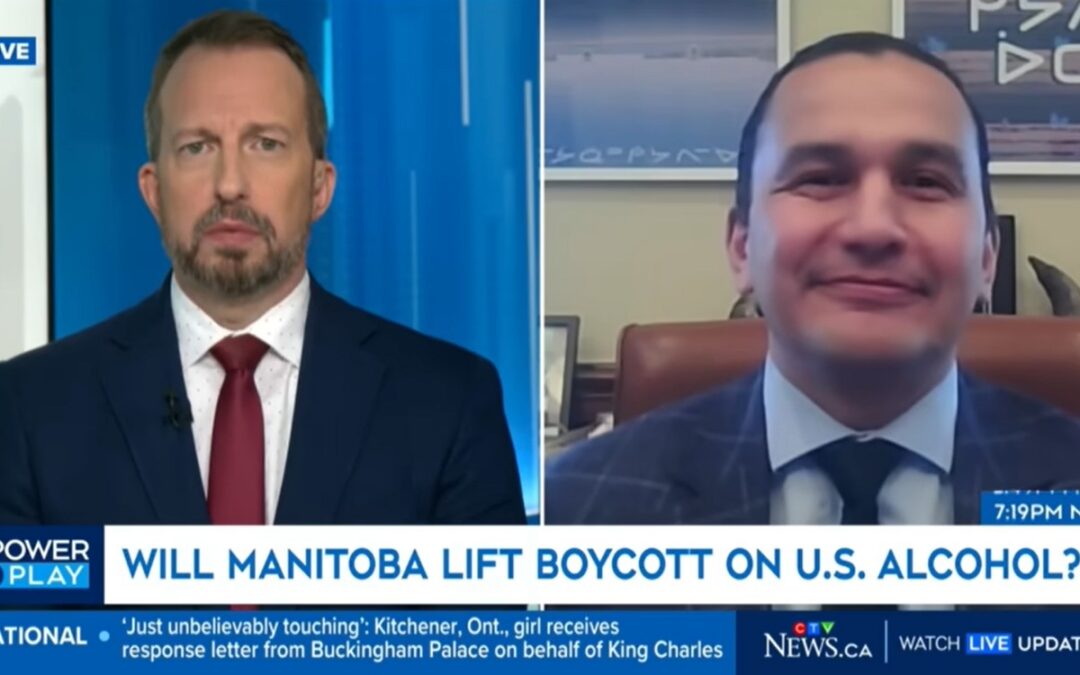
A CTV reporter recently asked Wab Kinew, premier of Manitoba, under what conditions he would lift his province’s ban on American booze. Most premiers, faced with that question, would have served the standard word salad: a few talking points about trade, a nod to federal-provincial cooperation, a polite redirection. Kinew did the opposite. He looked at the reporter and said, with a straight face, that maybe Canada should up the ante. Maybe the Americans should release the Epstein files. Then we will talk about lifting the booze ban.
The reporter’s face froze. He spent the next forty seconds trying to say anything other than the words « Epstein » and « files ». Kinew watched him struggle, smiled, and moved on. The clip traveled. Anyone who watched it twice came away with the same thought.
This man does not sound like a Canadian politician.
The vanishing art of saying what you mean
For a generation, the Canadian political class has perfected a single skill: the ability to talk for ninety seconds without committing to a position. Pierre Poilievre slogans his way through every file. Mark Carney technocrats his way through every press conference. Danielle Smith picks a fight with Ottawa before her morning coffee. Even competent provincial leaders, the ones who actually move files, tend to deliver their answers through a thick filter of brand management.
Kinew speaks like none of them. Asked about Ottawa’s signal that federal support for the Churchill port expansion might hinge on liquefied natural gas shipping by 2030, he did not posture. He did not pick a fight. He acknowledged the timeline was « pretty much unprecedented », said he took it as a challenge, and committed to moving heaven and earth to deliver. No spin. No grievance. No theatre of injured provincial pride. Just the position, laid out clean.
That is, in 2026 Canada, a political miracle.
Kananaskis, or the test of a national figure
A few weeks earlier, in Kananaskis, Kinew was asked about a meeting he had held with Alberta First Nations chiefs. The context mattered. Twelve days before the Western Premiers’ summit, an Alberta Court of King’s Bench judge had quashed a separatist petition seeking a referendum on Alberta independence, ruling that Danielle Smith’s government had failed in its constitutional duty to consult the Athabasca Chipewyan, Blood Tribe, Piikani, and Siksika First Nations on a question that would impact Treaties 7 and 8. The First Nations had stopped the push for separation. Not Ottawa. Not the courts on a technicality. The treaty holders themselves, asserting Section 35.
Kinew could have stayed neutral. He could have hedged. Instead, he stood in front of cameras, on Smith’s own home turf, and called himself a patriot. He thanked the Alberta chiefs for stopping the referendum from moving forward. He passed on a message from an older woman working at an A&W in Calgary: «Tell our premier we don’t want to separate from Canada ».
Then he repeated the whole answer in French.
Pause on that for a moment. A First Nations premier of Manitoba, on Alberta soil, dismantling the separation flirtation by telling a story about an A&W cashier, throwing in a self-deprecating Connor McDavid joke, and pivoting to French because a reporter asked him to. Without notes. Without a teleprompter. Without losing the thread. The French was not the careful, scripted French of an English Canadian politician working through a translation. It was the easy French of someone who learned the language as a child in immersion and never stopped using it. The kind of French that lets you debate Yves-François Blanchet on his own terrain without losing every exchange. The kind of French the federal NDP has not had in a leader’s chair since Mulcair, and the absence of which cost them most of their Quebec seats.
That is not a provincial politician. That is a national figure who has not yet been told he is one.
The profile that no one else has
The Canadian political market, right now, is starved of a particular kind of candidate. The country wants someone who can hold the federation together without lecturing it. Someone who can talk to Quebec in French without sounding like a hostage video. Someone who can talk to Indigenous nations not as a guest, but because he carries the language and the lineage himself. Someone who can talk to the West without selling out central Canada, and to central Canada without contempt for the West.
Kinew checks every box, and a few that no one else can.
He is Anichinabé, from the Onigaming First Nation in northwestern Ontario, Treaty 3 territory. He speaks ojibwé, English, and French, the last picked up in a French immersion school as a kid. He was elected the first First Nations premier of any Canadian province in 2023. He runs Manitoba as a New Democrat, but governs like a centrist pragmatist who happens to believe the federation is worth defending. He talks about Western Canadian resources and Indigenous treaty rights in the same paragraph, without contradiction, because in his world, they are not in contradiction.
Trilingual. Premier. First Nations. NDP. Western. Pro-Canada. Forty-four years old.
Nobody else in the country has that résumé. Nobody is close.
The voice the country forgot it needed
What makes the Kinew profile dangerous, in the best sense, is not the demographic checklist. It is the voice. The country has spent a decade being shouted at by politicians who treat every microphone as an opportunity to perform grievance. Doom and gloom from one side. Sunny ways and managed sentences from the other. In between, a population that has stopped listening.
Kinew breaks that pattern because he sounds like a person. He cracks jokes that are sometimes bad and admits when he is making them. He answers the question that was asked, not the one he wishes he had been asked. He gives credit to opponents in public. He passes on quotes from A&W workers as if they mattered, because in his framework, they do. He treats voters like adults.
This is rarer than it should be.
A national party without a national figure
Look at the federal landscape. The Liberals have Mark Carney, who is competent, ten years older than the country wants, and visibly tired of explaining himself. The Conservatives have Pierre Poilievre, whose entire pitch is that everything is broken and somebody is to blame, a message that grinds the listener down over time. The NDP, after losing all but six seats in 2025, elected Avi Lewis in March 2026 to a position roughly equivalent to captain of a sinking ship. Forty-four percent of past NDP voters polled during the race could not name a single leadership candidate.
The federal NDP, in other words, is rebuilding in public. Lewis is a transitional figure carrying a transitional mandate. The party will live or die on whether it can find a leader Canadians actually want to listen to within the next electoral cycle.
Kinew is the answer the party will not yet let itself say out loud. He is loyal to his Manitoba mandate, just re-elected, with a province to run. Today is not the day for the leap. Nobody is asking him to make it tomorrow morning, either.
But the file is open. The arithmetic is open. The Canadian electorate’s patience with the current cast is wearing thin.
The path nobody is mapping yet
Here is the case for the leap, when it comes.
A First Nations premier of a Western province, leading a federal center-left rebuild against a Conservative party that has lost three elections and a Liberal party that will be running on fumes by 2029. A national unity argument grounded in actual treaty relationships, not abstract patriotism. A Western candidate who can close the credibility gap the federal NDP has carried in Alberta and Saskatchewan for a decade. A reconciliation story told by someone who has lived the file from the inside, not someone reading a briefing book.
Nobody in either of the two governing parties can match that profile. Nobody in the NDP’s current bench can either. The window will not stay open forever. Federal politics is impatient. A premier who waits two terms too long becomes a regional curiosity instead of a national choice.
The Manitoba moment
Manitobans did something in October 2023 that the rest of Canada is still catching up to. They elected, by a comfortable margin, the first First Nations premier in the country’s history. They did it because Kinew ran a clean campaign on health care and unity, and because, watching him talk for ninety seconds, voters figured out something the political class still has not.
He sounds like one of us.
A British Columbian voter has never heard of him. A Quebec voter has heard the name and nothing else. A voter in St. John’s or Halifax probably could not place him on a map. That is the cost of the federation: ten provinces, ten political ecosystems, ten parallel conversations. Most premiers stay locked inside their own.
Kinew will not stay locked. The profile is too rare. The country’s appetite is too obvious. The political vacuum is too wide.
When the leap comes, watch for it. It will be the most important Canadian political move of the decade. And the rest of us will spend the next morning explaining to friends in the rest of the country who this man from Manitoba is, and why we should have been paying attention all along.