
What the taxman won’t tell you about bricks and mortar: seven duels, one house, one plex, one corporation, and the only judge who ever decides at the table.
What the taxman won’t tell you about bricks and mortar: seven duels, one house, one plex, one corporation, and the only judge who ever decides at the table.
In 2023, Netflix reopened one of finance’s deepest wounds. Madoff: The Monster of Wall Street told the Bernard Madoff story, the money manager who ran the largest Ponzi scheme ever recorded: roughly 37,000 victims across 136 countries, statements that showed some 65 billion dollars of wealth that had never existed. Retirees, charities, a Nobel laureate’s foundation, ordinary savers who had done the one thing everyone told them to do: hand their money to a professional. The genius of Wall Street. The man who never had a down year.
He never had a down year because there was no year. No fund. No trade. Just new money paying old money, decade after decade, until December 11, 2008, when the music stopped. Even the size of the theft turned out to be a mirage: 65 billion on the statements, closer to 17 billion actually paid in, of which the trustee has since clawed back about 75 cents on the dollar. Madoff got 150 years. He died in a prison hospital in North Carolina in 2021, still owing the arithmetic.
Somewhere in that wreckage sits the archetype the cameras always find: the retired couple who signed everything over to the nice man with the «split-strike» strategy, then watched the account go to zero. And the lesson the neighbors drew, the one that outlives every fraud: he should have bought a building. Bricks would have saved him. Stone never lies.
That is the idea worth taking apart. Because it does not come from a screenplay. It lives in our collective imagination. In Canada, real estate is the lifeline, the investment that never betrays you, the last safe harbor.
Let’s settle one thing before the first punch is thrown. Judging an asset class through the story of a crook rigs the fight before the bell. Madoff did not post a weak quarter. He stole. What his victims lost says nothing, absolutely nothing, about whether the market beats real estate over twenty years. Theft is not a return. Filing Madoff’s crime under the «stock market» column of the great match is like blaming the automobile for the drunk who drove it into a wall. The documentary has every right to move you. We do not have that luxury.
So we do the opposite. We throw the fraud out of the equation. We compare real estate against what an honest investor would truly have earned: a real portfolio, a real index, every dollar drawn from the same pocket, at the same moment, on both sides. One guest is still missing from the table, the one nobody thinks to invite to the kitchen counter: the taxman. He is the one who decides. Not a landlord’s mood. Not a saver’s fear.
Which leaves us needing someone who actually chose the bricks. Take Sarah Mitchell.
PART I. The house against the taxman: the match no one ever runs the numbers on
Sarah Mitchell is twenty-two in 2006. A tech entrepreneur in Montreal, that year she makes her first grown-up decision: she buys her house. $250,000: a down payment of $62,500 and a mortgage of $187,500 at 4.5% over 25 years. Nothing exotic. The path of millions of Canadians.
Twenty years later, the question everyone asks around a kitchen table fits in one line: was she right? Or would the same money, poured into the market through a TFSA and an RRSP, have done better? Because this match does not pit a pampered investment against a bare one. On both sides, the taxman has pitched a tent. On the house, the exemption. On the market, the TFSA and the RRSP.
Everything suggests the answer is simple. It is not. And the referee of the match, the one we always forget to invite, is the taxman.
The only gain the taxman never touches
Let’s start with the house. Twenty years on, using the comparables method, meaning recent sales of similar properties in the same area as compiled in the MLS system (Centris, in Montreal’s case), it is worth roughly $802,000. That figure is not a homeowner’s daydream. It is what real buyers paid, a few streets over, for comparable houses. Our 6%-a-year growth assumption merely draws the line between two dots: the price paid in 2006 and what the local market pays in 2026.
The gain is close to half a million. And the State will not see a cent of it.
This is the principal residence exemption. The definition sits in section 54 of the Income Tax Act, and the calculation mechanics are in paragraph 40(2)(b) ITA. As long as it is the roof you live under, every dollar of appreciation is yours. Not half, as with an ordinary capital gain. All of it. For Sarah, roughly $135,000 in tax avoided, with no planning, no structure, no adviser. The principal residence is the golden goose of the Canadian tax system, and almost no one looks at it as an investment.
Six percent, provided you pick up the hammer
Where does that 6% come from? Not out of a hat. Over 20 years, the single-family home in the Montreal region went from a median price of nearly $215,000 in 2006 to almost $649,000 in 2026, a compound annual growth rate of nearly 5.7%. On the island, where the average price has surpassed the million-dollar mark, the pace is over 6%. The figure used here, therefore, tracks the real market for a well-located, well-kept property.
Let’s state the assumptions, because a number without assumptions is an opinion. The 6% annual growth does not fall from the sky. It assumes optimal maintenance, roughly 1.5% of the building’s value per year, or $2,625 for this house. Roof, windows, kitchen: growth is bought at the hardware store.
Skip the maintenance and the model turns merciless. The land continues to track the market, but the building depreciates by 2.5% per year. The same house, taken to a broker in 2026, would find a buyer only near $346,000 instead of $802,000. Comparables show no mercy: buyers pay for the renovated house next door, not for yours. An amputation exceeding $450,000. A building you don’t maintain is not an investment. It is a plot of land dragging an expense behind it.
The rule of the game: every dollar, at the same moment
Now, the match. Sarah against her double, an identical twin who, in 2006, chooses to rent and invest in the market. For the comparison to hold, one rule only: every dollar leaves the same pocket, at the same moment, on both sides.
The $62,500 down payment becomes a $62,500 deposit into investments. The $12,645 annual mortgage payment becomes a $12,645 annual contribution. The homeowner’s taxes and maintenance, about $5,600 a year, serve as the renter’s rent. Let’s be honest: this notional rent of $470 a month is a gift to the market, since no house rents for that amount. If the house still wins, the argument only gets stronger.
The TFSA first. But the TFSA was born in 2009.
Where does the twin’s money go? To the best shelter first: the TFSA, section 146.2 ITA, where everything is tax-free, forever. Except one detail is fatal. In 2006, the TFSA does not exist. It is born in 2009, with a $5,000 annual limit. It climbs in small steps: $5,500, a jump to $10,000 in 2015, then $6,000, $6,500, $7,000. By 2026, the cumulative room total is only $109,000. Out of nearly $320,000 in total outlays, the TFSA shelters only a fraction.
The rest goes to the RRSP under section 146 of the ITA. And the RRSP is not a shelter; it is an advance. The contribution is deducted from income; the taxman refunds 45 cents on the dollar for a taxpayer like Sarah, and that refund, reinvested the following year, works as tax leverage. But on the way out, the entire RRSP is taxable. Its displayed value is an optical illusion: an RRSP of $858,000, withdrawn at 35%, is worth only $558,000.
The numbers
Why 7%? It is the nominal return a balanced portfolio has historically delivered over the long run, dividends reinvested. Let’s be clear about the reference: the 2026 Projection Assumption Standards of the Institut de planification financière (formerly the IQPF) use 4.8% instead for a balanced portfolio. But that floor is contested. Several portfolio managers call it far too conservative, a regulatory caution that understates what the markets have actually paid over twenty years. So we won’t choose. We compute both, and everything in between.
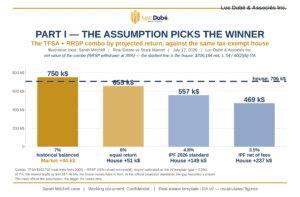
At the central return of 7%, the market twin ends up with a TFSA of $192,700, a gross RRSP of $857,956, and a net total of $750,371 after spreading her withdrawals at 35%. The homeowner ends up with $706,184 net, exempt under paragraph 40(2)(b) ITA, after selling costs and mortgage balance.
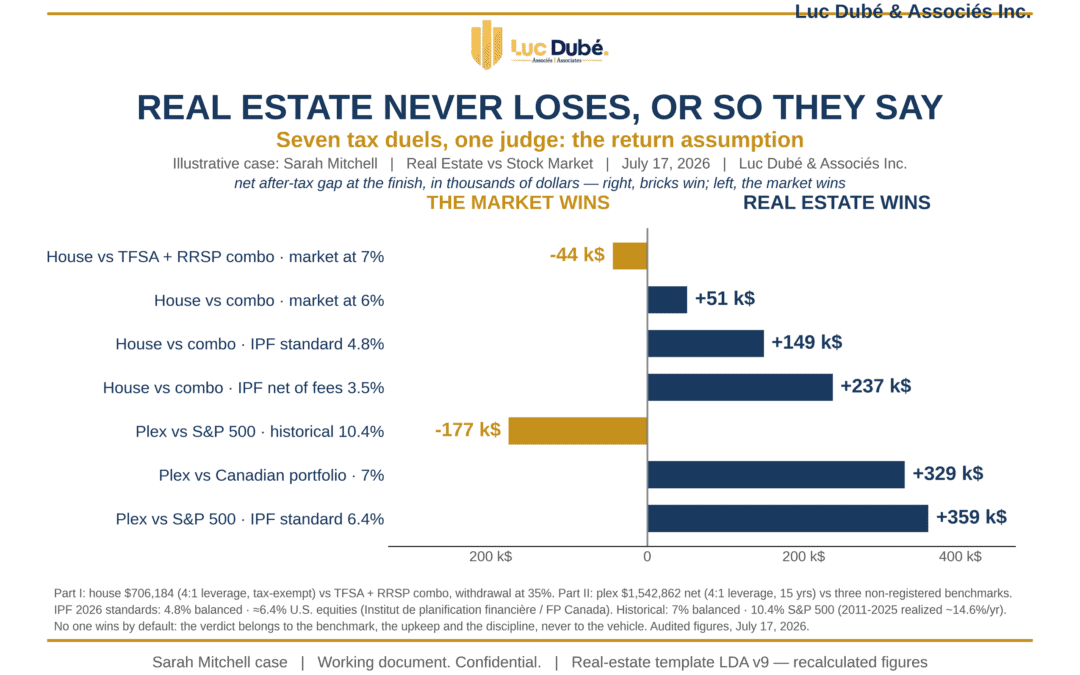
On paper, the TFSA + RRSP combo wins, but only by a hair: $44,187.
And that slim lead hangs by a thread. Tighten the assumptions by one notch, and it evaporates. At an equal return, 6% on both sides, the combo drops to $655,232, and the house moves back in front by $50,953. Shift the RRSP withdrawals to 40% instead of 35%, and it is a dead heat, within a thousand dollars.
Slide the standards dial
Now go down the scale to the official figure. At 4.8%, the return the Institut de planification financière prescribes for a balanced portfolio, the combo lands near $557,000. The house wins by some $149,000. Strip out ordinary management fees of 1.3%, meaning a net return of about 3.5%, and the combo slides toward $469,000: the house wins by roughly $237,000. The full scale fits on one line: at 7%, the market leads by $44,000; at 6%, the house leads by $51,000; at 4.8%, by $149,000; at 3.5%, by $237,000. The more official the assumption, the bigger the house wins.
Take the lesson of method, because it holds for the whole file: the verdict does not belong to the vehicles, it belongs to the assumptions. Whoever controls the projected return controls the winner.
And take leverage out of the equation. Paid in cash, the same house leaves only $761,695 of comparable enrichment, well below what the market pays on the same sums at 7%. There is the secret the numbers spit out: it is not the exemption that makes the house win, it is the exemption multiplied by leverage. A four-to-one leverage, blessed by your banker, that the market simply cannot copy.
The real world: when you don’t follow the plan
Everything above assumes the discipline of a monk. Twenty years of contributions, never a miss, never a raid on the pot. Real life looks nothing like that.
Give the market twin a human path. She skips her contributions four years out of twenty: 2008 and 2009, because markets are collapsing and fear paralyzes; 2015, because life is expensive; 2020, because of the pandemic. She withdraws $25,000 from her TFSA in 2018 for a renovation and never puts it back. She takes $30,000 from her RRSP in 2022, a rough patch, and that room is gone for good. Nothing scandalous. Everyone’s path.
The result: her combo melts from $750,000 to $560,000. Nearly $190,000 evaporated in four skipped years and two withdrawals. And there she sits, behind the homeowner, who did nothing special except pay her mortgage because the bank gave her no choice.
That said, the house has its own way of failing, and it is worse. The homeowner who puts the hammer away for twenty years ends at $270,000 net. The building you don’t feed, the portfolio you don’t feed: every tax shelter has its own way of punishing neglect. The house forgives financial indiscipline. It never forgives maintenance indiscipline.
What really decides it
The mortgage is forced savings. The bank does not ask whether you feel motivated this month. The RRSP, for its part, demands twenty years of loyalty, tax refunds reinvested included, and a well-timed exit at the right rate.
And there is something more fundamental. Try to copy the homeowner’s leverage in the market. The rules forbid it: you cannot pour $250,000 into registered plans in 2006. Subsection 18(11) ITA drives the nail in: interest on a loan taken to contribute to an RRSP or a TFSA is not deductible. As for the brokerage margin, it runs about two-to-one on ordinary securities, and it gets called in the middle of a crisis. It would have liquidated you at the bottom. The mortgage, on the other hand, never calls you in as long as you pay.
In short, the principal residence is the only Canadian tax shelter with no ceiling, no withdrawal condition, and one your banker agrees to finance at four to one. The TFSA + RRSP combo can beat it at the finish line, but it demands return, consistency, and a well-orchestrated exit. The house asks only two things: that you live in it, and that you maintain it.
The taxman did not create a winner. He created two shelters. Most people fill only one. And almost no one follows the plan to the end.
PART II. The plex: real estate without a net
A rental building held personally against the S&P 500. No exemption on one side, no tax credit on the other. The most honest duel in the file.
Let’s pick Sarah up in 2011. The house is bought, business is humming, and she makes the move thousands of Quebecers make when the bank account overflows: she buys a plex. One million dollars, a $250,000 down payment, and a $750,000 mortgage at 4.5% over 25 years. With acquisition costs and a prudence reserve, she commits $285,000 of capital.
This time, no exemption. The one from Part I, section 54 and paragraph 40(2)(b) ITA, is reserved for the roof you live under. A rented plex is an investment: the rents are added to income each year, and the capital gain will be taxed on sale.
But be careful. No exemption does mean no tax weapons. Investment real estate carries two, and they are serious.
What the plex really earns
Set out the numbers, at Montreal-market comparables. A million-dollar plex generates about $50,000 in gross rents. Exclude vacancy and bad debt (roughly 7%): $46,500 in effective income remains. Subtract property taxes of $12,000 and operating expenses of $11,625, and net operating income comes to $22,875. A capitalization rate of 2.3%.
Now add the $11,250 in annual renovations. They are not a choice; they are the price of the 6% growth: 1.5% of the building’s value every year, or the model jumps the rails. The building that misses its maintenance depreciates by 2.5% a year while the neighborhood comparables keep climbing. All the growth in this file is maintained growth, and paid in cash.
Facing this income, the bank. Debt service swallows $50,579 a year: $33,750 of interest in the first year, $16,829 of principal. The hole is real. But here come the two tax weapons.
The first: interest is deductible. This is paragraph 20(1)(c) ITA; money borrowed to earn income from property gives the right to deduct its interest. On the principal residence in Part I, not a cent of interest was deductible. On the plex, every dollar is. The second: maintenance renovations, paid out of rents and the owner’s pocket, are deductible current expenses as well, as long as they are repairs without transforming.
But there is a third line in the mortgage payment, and that one the taxman does not even glance at. The $16,829 that repays principal in the first year is paid with after-tax dollars and is deductible nowhere. Repaying a debt is not an expense; it is an outlay of a capital nature, shut out by paragraph 18(1)(b) ITA. The CRA’s Income Tax Folio S3-F6-C1, «Interest Deductibility», draws the line without ambiguity: paragraph 20(1)(c) ITA opens the door to interest, and to interest alone. Over fifteen years, $349,780 of principal will thus be repaid without generating a cent of deduction. Is it money lost? No. Every dollar of principal repaid becomes a dollar of equity in the building. It is the forced-savings share of the investment, the one that earns nothing on the T776 but waits for you at the sale. The deduction rewards the cost of money. It never rewards the enrichment.
Add it all up: interest, renovations and expenses far exceed the net rents. The plex throws off a rental loss of about $22,100 in the first year, a real one, and that loss is deducted from Sarah’s other income, which is high. The taxman refunds her about $9,950. Result: her net outlay settles around $29,000 in the first year, and drifts toward $31,600 as the interest melts, and the refund shrinks. The Montreal plex does not support its owner. It is the owner who supports it, with the taxman as the discreet roommate of the deficit.
The rule of the game, restated
Same rule as in Part I: every dollar leaves the same pocket, at the same moment, on both sides. The market twin receives the $285,000 at the start, then the same annual outlay, from $29,000 to $31,600, year after year. Over the fifteen years, each will have committed about $736,000.
But this time, her shelters are full. The TFSA and the RRSP were consumed in Part I. All that remains is the ordinary account, the non-registered one, where the taxman drops by every year. In it she places the market’s toughest opponent: an S&P 500 index fund, hedged into Canadian dollars, at minimal fees. Return used: 10.4% net, split into 8.9% growth and 1.5% dividends. A word on this figure, because it differs from the 7% in Part I, and the difference is no whim. Part I pitted the house against a balanced portfolio; here, the opponent is a pure equity index, whose long-term historical return runs close to 10%. The reader who prefers the Institut de planification financière’s official benchmark will find the verdict a few lines below.
And here, a tax lesson few investors ever master. Those dividends are American. No dividend tax credit, unlike Canadian banks and pipelines. They land each year on a slip, taxed at the full marginal rate, 53.31% at the Quebec top, with the 15% U.S. withholding coming back as a credit. That is the price of the foreign. But look at the paradox: despite that punishing rate, the index’s annual friction is smaller than a Canadian dividend portfolio’s, because its dividend yield is tiny. One and a half percent taxed at 53% rubs less than four percent taxed at 40%. Over fifteen years, the index leaves about $109,000 in drag tax, where the Canadian portfolio leaves around $165,000. The bulk of the S&P’s return is growth, and growth pays nothing until you sell. The growth index is, in its own quiet way, a small tax shelter. It defers.
The numbers
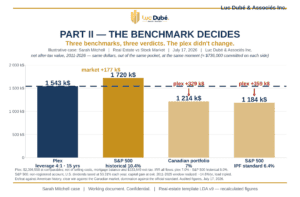
At the finish, in 2026, the verdict. The building is worth $2,396,558 at comparables. After selling costs, the mortgage balance, and the exit tax of $333,649 (half of the $1.25-million gain, taxed at 53.31%), $1,542,862 net remains in Sarah’s hands. Internal rate of return, all flows counted, the down payment as well as the annual injections: 7.0% a year. Respectable. Solid, even.
The index, for its part, ends at $1,720,270 net, drag tax and capital gain settled. Internal rate of return, measured the same way: 8.0%. Advantage S&P 500: $177,408.
Take the blow, then understand it. The four-to-one leverage let an asset growing at 6% almost keep pace with an asset compounding at 10.4%. Almost. On a gross value basis, Sarah’s stake grows at 11.9% per year, compared with 12.7% for the index. Leverage is a multiplier, not a miracle. It amplifies the return of the asset you feed it. It does not replace it.
And a confession of method, before the sharp reader makes it for us: the 10.4% used is the long-term average, not the window actually lived. From 2011 to 2025, the S&P 500 really compounded at around 14.6% a year. Served at that pace, the index would not have beaten the plex by $177,000. It would have left it in the dust threefold. Our historical benchmark is, itself, a conservative benchmark.
The benchmark decides
A defeat against the S&P 500, but not against everyone. Against the Canadian dividend portfolio, banks and pipelines at 7%, the same plex wins by $328,695. And against the S&P 500 projected at the forward-looking standards of the Institut de planification financière, about 6.4% for U.S. equities, the plex dominates: $1,542,862 against roughly $1,184,000, a gap of some $359,000 in favor of real estate.
Three benchmarks, three verdicts. Defeat against American history. Clear win against the Canadian market. Domination against the official projection. The plex did not change. The benchmark changed. The verdict on a real-estate investment is never rendered in the absolute. It is rendered against what your money would have done elsewhere, and that «elsewhere» makes all the difference. Be wary of anyone who claims to know, in advance, the return on the other side.
Leverage against leverage
Push the honesty all the way: what if the twin borrowed too? Brokerage margin, two to one. That is the ordinary ceiling, though the most liquid index funds sit on the reduced-margin list and can be pushed closer to three-to-one, which would only sharpen the gain and the danger alike. We keep the conservative figure. $285,000 borrowed at 6.5%, interest deductible under the same paragraph 20(1)(c) ITA as the plex. The tax symmetry is perfect; only the scale differs: $750,000 of leverage on one side, $285,000 on the other.
The result, if all goes well: $2,080,466 net, an internal rate of return of 9.8% on all flows. More than half a million ahead of the plex. On paper, a rout.
On paper. Because here, the risk stops being a footnote. The danger of margin is packed into the start. A 35% drop, 2008 or March 2020 caliber, in the first two years, sends the coverage below the broker’s maintenance requirement, often set between 30% and 35%: a call within twenty-four hours, forced liquidation at the bottom, losses crystallized, end of story. The same drop in year nine triggers nothing, the leverage having diluted itself. And the S&P 500, precisely because it earns more, falls harder: down 37% in 2008, down 34% in March 2020. Add this, which no one says out loud: under the IPF’s forward-looking standards, a 6.5% margin no longer even beats the plex. It ends around $1,280,000, some $260,000 behind. Borrowing at 6.5% to hope for 6.4% is paying for the privilege of carrying risk. Margin on the U.S. index is the most profitable and most suicidal weapon in the file, and it only pays if history repeats.
On the plex side, no margin call, but other bills. The term is renegotiated every five years, at the rate of the day, and 2022 remembers. A vacant unit, a tenant who stops paying, a file at the Administrative Housing Tribunal, and the annual outlay swells. Selling takes months. And everything rests on a single asset, in a single neighborhood of a single city. The plex does not get a margin call. It gets calls from the plumber.
CCA: why we claim nothing here
A word on depreciation, that urban legend of investor dinners. The 4% declining-balance capital cost allowance on the building is supposed to be the great tax advantage of real estate. In this file, it is never used. Not a single year. Interest and maintenance already wipe out all the taxable rental income, and then some. CCA, which can neither create nor deepen a rental loss under Regulation 1100(11), simply has nothing left to deduct.
And that is good news in disguise. Having claimed no CCA, Sarah suffers no recapture under subsection 13(1) ITA on the sale. Those who sing the praises of CCA always forget this half of the story: every dollar depreciated comes back into income in the year of the sale, taxed at 100%, often at the worst rate of a lifetime. CCA is not a gift. It is an interest-free loan the taxman grants, then reclaims with a smile, in a single block, at the very moment you thought yourself rich. Our position, when it becomes available in a file: we don’t claim it by reflex, we calculate it. The logic fits in three words: simplicity, neutrality, serenity. The real tax advantage of the rental lies elsewhere and runs through the T776 every year: interest and maintenance.
What’s left on the table
Sarah’s plex beat the Canadian portfolio by $328,695, bowed by $177,408 to the American index, served at its historical return, and dominated the same index, projected at the official standards, by some $359,000. Its weapons were not the ones people think. No exemption, no CCA, but off-the-charts leverage, deductible interest and maintenance every year, and $350,000 of forced savings built by repaying principal. It did all that in personal ownership, with a rental loss that lightened her entrepreneur’s taxes along the way.
Which leaves the question every entrepreneur eventually drops on the accountant’s desk: «And what if I put it in a corporation?» The corporate rate is low, after all. That is the next step. And the answer will surprise more than a few, though not for the reasons people expect.
PART III. The plex in a corporation: the mirage of the low rate, and what it hides
Sarah puts her plex in a corporation. She has heard about the famous 12% rate. She is about to discover that it is not for her, that the real rate frightens for nothing, and that the cost of the detour hides somewhere else entirely.
One evening, Sarah’s lawyer slips her the line every business lawyer slips: «Put your building in a corporation. It’s advantageous, for tax and legal reasons.» She listens. She incorporates. One corporation, one asset, the plex.
Rolling the building in is not tax-free by accident. Without a section 85(1) election, form T2057, the transfer would be a deemed disposition at fair market value under paragraph 69(1)(b) ITA, the accrued gain and the recapture triggered on the spot. She files the election, so the plex moves at cost. In Quebec, the transfer duty, the famous welcome tax, is waived because she holds more than 90% of the shares immediately afterward. The roll-in is clean. The bill, as always, comes later.
On the legal side, asset protection exists, and I’ll stop there. I am not a jurist, and I refrain from weighing its scope. On the tax side, the numbers have just spoken, and I’m getting to them. But first, the mirage.
The 12% rate isn’t for a building
In Quebec, a corporation pays about 12.2% on its income, a laughably low rate that makes every entrepreneur dream. But that low rate targets only one thing: income from an actively carried-on business. A shop, a factory, a firm. Real work, real employees, a real business.
A rented plex is none of that. Under the Act, collecting rents is not carrying on a business; it is earning income from property. And without at least six full-time employees, the rental becomes what the Act calls a specified investment business, as defined in subsection 125(7) of the ITA. The consequence is blunt: the plex fails to meet any of the tests required for the low rate. None.
So we compute with the other figure. The real one. The investment income of a private corporation in Quebec is taxed at 50.17%. Not 12%. Fifty point one seven. And while we’re at it, let’s close the other door: the capital gains exemption of section 110.6 ITA does not apply either, because the shares of a corporation that holds only a rental building are not qualifying shares. Two mirages, two doors shut, before we have even started.
What the corporation changes, and what it doesn’t
What doesn’t change, first. The corporation collects the rents, pays the mortgage, deducts the interest under the same paragraph 20(1)(c) ITA. The principal repaid stays non-deductible, exactly as in personal hands. The bank lends to the corporation, with the shareholder as guarantor. Nothing new under the sun.
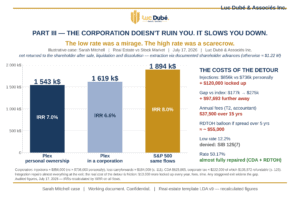
What changes fits in one sentence: the rental loss no longer meets Sarah’s other income. In personal ownership, that loss of about $22,100 was a blessing. It wiped out against her tech income at 45%, and the taxman handed her back nearly $9,950 a year. In a standalone corporation, losses pile up in a corner as loss carryforwards under section 111 ITA relieve nothing at all in the meantime. The math is final: where personal ownership cost her about $29,000 out of pocket each year, the corporation costs her nearly $39,000. Ten thousand dollars more, every year, locked in a shell, earning nothing. Add the accountant, the T2, the registrar, about $2,500 a year, or $37,500 over fifteen years. In total, the corporate detour will have swallowed some $856,000 in injections, against about $736,000 in personal ownership. The tax shield did not vanish. It was postponed to a distant day, the day of the sale.
The temporary-tax balloon
And this is where corporate ownership reveals its most misunderstood mechanism. Of that 50.17%, part is not permanent. About 30 points are a temporary, refundable tax, a deposit the corporation leaves with the taxman and recovers only by paying taxable dividends. It is the refundable dividend tax on hand under section 129 ITA, funded by the additional tax under section 123.3 ITA. Remember the word: temporary. Not free. Temporary. It is a balloon. It swells, gorged on your own tax, and it deflates on one condition only: emptying the accounts.
Selling to burst the balloon
So she sells, and everything unwinds at once. The corporation’s gain: $1,251,730. The non-taxable half, $625,865, is credited to the capital dividend account and will be paid out tax-free. The taxable half, reduced by the roughly $184,000 of accumulated losses, bears corporate tax of about $222,000, of which $135,572 is refundable. Then we siphon, in order: the repayment of Sarah’s advances, tax-free; the capital dividend, exempt; and the balance in taxable dividends, taxed in her hands, which at the same moment triggers the refund of the temporary tax. The shell, emptied, is dissolved.
A point of method, because it carries the whole result: this unwinding assumes that every dollar Sarah injected, the stake as well as the annual deficits, was documented as a shareholder advance repayable tax-free. That is standard practice, but it cannot be presumed. Without that paperwork, everything that leaves the corporation is treated as a taxable dividend, and the net drops by about $400,000. The difference between an advance and a poorly documented contribution is 0% versus 48.70%. Keep your records.
A word on this capital dividend account, because too much nonsense gets written about it. The CDA is not an advantage. It is a leveling. It applies the integration principle, the idea that income should not be taxed more simply because it passes through a corporation. In personal ownership, the non-taxable half of a gain comes straight back to you, tax-free. The CDA merely reproduces that result. Anyone who sells it as a gift has not understood that it is only an integration patch.
The numbers, and the double lesson
Do the math end to end. At the end of the road, the corporation hands Sarah $1,619,385, against $1,542,862 in personal ownership. More money at the finish line? Yes, but she swallowed far more along the way: $856,000 in injections against $736,000. Spread over all flows, the internal rate of return drops from 7.0% personally to 6.6% in a corporation. The shell cost nearly half a point of return a year, every year, for fifteen years.
Against the market twin fed the same outlays, the verdict deepens: the index ends at $1,894,486, an internal rate of return of 8.0%. The gap: $275,101 in favor of the market. And here is the gut punch. In personal ownership, the index was winning by $177,408. In a corporation, the gap climbs to $275,101. Incorporating the plex did not bring Sarah closer to the index. It carried her $97,693 further away.
But hold on to the reverse lesson too, the one you never hear at dinner parties. The dreaded 50.17% confiscated almost nothing. Between the capital dividend account, the refundable tax recovered, and the loss carryforwards finally used, the integration machinery did its job on the way out. The low rate was a mirage. The high rate was a scarecrow. The real price of the corporation is elsewhere: ten thousand dollars more locked up every year with no return, $37,500 in professional fees, fifteen T2 returns, and the balloon. Spread the dividends over five years to spare the brackets, and the temporary tax sleeps at the taxman’s the whole time. At a 7% return, that sleep costs about $9,500 a year, nearly $55,000 over five years.
The corporation does not ruin you. It slows you down.
And at the IPF’s forward-looking standards, the ranking flips again. Against an S&P 500 return of 6.4%, corporate ownership of the plex maintains a lead of about $255,000. The benchmark, once more, decides the podium. The structure, for its part, only chips points of return off the road.
A trap narrowly avoided
An aside, because it could have changed everything. Had Sarah housed her plex in a corporation associated with her tech business, another provision would have woken up, subsection 125(5.1) ITA. The gain on the sale would have inflated her investment income and, the following year, reduced the small business deduction for her active corporation to zero. About $71,500 gone. She dodged it by keeping her real-estate corporation standalone. The lesson fits on one line: never mix passive investment and active business under the same corporate roof without knowing exactly what you are doing.
The detour that lengthens the road
The real-estate corporation is not a mistake in itself. It is a tool, and like any tool, it serves when it serves. For asset protection, for a high-income building you capitalize and keep for decades, for an estate you are preparing, it finds its hour. Our plex is none of those cases. It loses money every year; it will be sold, and its owner has a high income and loves an annual deduction. For her, the corporation postponed the relief rather than offering it, locked up capital rather than freeing it, and shaved nearly half a point off the return every year. The low rate was a mirage. The high rate was a scarecrow. The real cost sat in the fees, the advances, and the wait.
A deeper study of the comparative advantages of corporate versus personal ownership will follow shortly. It will say when the corporation wins, because sometimes it does. But not here. Not for this plex. Not for Sarah.
The verdict Madoff never let anyone see
So who wins, the bricks or the market? Read the seven duels again. At 7%, the market takes the house by $44,000. Drop to 6%, and the house takes it back. At the official standard, the house wins in a walk. The plex loses to American history, crushes the Canadian market, and buries the official projection. Same house. Same plex. Different assumption. Different winner every time.
Nobody wins by default. Not the bricks, not the index, not the corporation. The verdict belongs to three things the salesman never mentions: the benchmark you measure against, the upkeep you actually pay for, and the discipline you hold for twenty years. Never the vehicle.
Which brings us back to the nice man with the split-strike strategy. His victims did not lose because the stock market is dangerous and bricks are safe. They lost because a thief stole their money. Had they held an honest index instead of an imaginary fund, they would have ridden 2008 down and back up, and retired richer than the landlords next door. The lesson of Madoff was never «buy a building». It was «never confuse the vehicle with the driver».
Real estate never loses, they say. It does. So does the market. The only thing that never loses is the taxman, and even he, it turns out, can be out-argued. You just have to read the file to the end.