
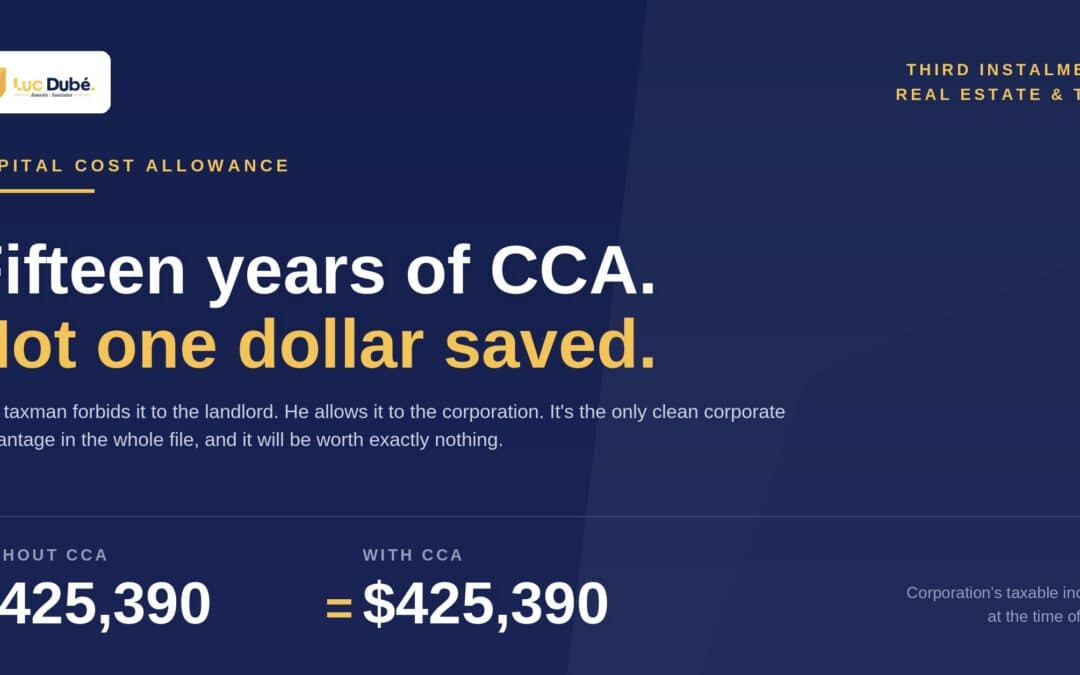
The taxman won’t let a landlord dig a rental loss deeper with depreciation. He lets a corporation do it. That is the first honest corporate advantage this whole file has produced. Now let’s see what it’s worth the day you sell.
The line always shows up somewhere between the main course and dessert. « With the depreciation, that building won’t cost you a cent in tax. » It travels from brother-in-law to lawyer, from lawyer to mortgage broker, and nobody ever asks to see the math. Nobody. Not once.
Claire Whitmore heard it in 2011. Software founder, Toronto, fresh off buying a million-dollar triplex in Leslieville: $250,000 down, a $750,000 mortgage at 4.5 percent over twenty-five years, and about $305,000 of real money on the table once closing costs and a rainy-day reserve were counted. And because this is Toronto, she paid the land transfer tax twice, one cheque to Queen’s Park and another to City Hall. That’s $32,950 gone before a single tenant wrote a cheque.
Two pieces have already chased this file around. The first, in three parts, put a Montreal plex up against the stock market, then shoved it into a corporation and knocked over two legends in a row: the small business rate never reaches a rental building, and the scary 50.17 percent rate confiscates almost nothing, because integration hands nearly all of it back when you empty the shell. The second ran the whole exercise again with Claire’s triplex, in a province that just raised the exit toll and called it something else. Both times, the real cost of the shell hid somewhere nobody looks: twelve thousand dollars more tied up every spring, $37,500 in accounting fees, fifteen T2 returns, a tax loss napping for fifteen years before it does any work.
A mirage, then a scarecrow. That left the third belief, the one with the thickest skin.
This time, the belief isn’t false. It’s incomplete. Which, as you’ll see, is worse.
The only expense that never leaves your account
Let’s start with how the thing works, because half the people who invoke it couldn’t explain it.
Paragraph 20(1)(a) ITA and Regulation 1100 start from plain common sense: buildings wear out. So the taxman lets you deduct a slice of the cost each year. Any building bought after 1987 lands in Class 1 and depreciates at 4 percent on a declining balance, component parts included: wiring, plumbing, furnace, elevator if you’re fancy. In the year you buy, the half-year rule cuts the deduction in half. Welcome aboard.
Here’s the strange part. This expense doesn’t touch your bank account. The interest goes to the bank. The property taxes go to the city. Capital cost allowance goes nowhere. It takes a piece of a purchase price you paid years ago and recycles it into a fresh deduction, while the market pushes the very same building up 6 percent a year.
An asset that gets older in Ottawa and younger at the Land Registry Office. The eloquent principle of the paradox.
Better still, the Act lets you claim it but never makes you. Nothing one year, half the next, full blast the year after. It’s one of the few taps in the whole system you get to turn yourself.
Trouble is, for most landlords the tap is padlocked. And the padlock has a number on it.
The padlock on the landlord
Regulation 1100(11). No provincial twin to worry about: since 2009 Ontario computes corporate taxable income on the federal base and lets the CRA run the show, so the federal rule is the only rule in town.
One sentence covers it. CCA claimed on rental property can neither create a loss nor increase an existing loss. It can take your rental income down to zero. Never below. And the calculation is done across all of your rental properties together: recapture in, terminal loss out.
Now watch it land on Claire, who owns the building in her own name. The triplex brings in $50,000 of gross rent, $46,500 once vacancy and deadbeats are accounted for. Take off $12,000 of property taxes, $11,625 of operating expenses, $11,250 of maintenance work and $33,750 of interest in year one. The hole is $22,100.
Allowable CCA: zero. Not fifteen thousand. Zero. Every year, for a decade and a half.
She doesn’t lose anything by it, mind you. That $22,100 loss wipes out an equal slice of her software income, taxed at just under 45 percent, and the CRA mails her back close to $9,800 the next spring. But the deduction everyone kept toasting at dinner never got used. Not once. For the vast majority of landlords, the ones whose building doesn’t pay for itself, the dinner-table legend dies right here, somewhere around the tiramisu.
One cousin of the rule deserves a mention, because it catches the clever ones. Furnished units, with a separate line in the lease for the furniture? Those chattels become leasing property under Regulation 1100(15): same logic, same padlock. The couch can’t dig a hole either.
The exception that flips the table
Regulation 1100(12)(a).
The restriction does not apply to a corporation whose principal business is the leasing, rental, development or sale of real property it owns. The doctrine spells out the consequence without blinking: such a corporation « may create a loss through depreciation ». The textbook example is practically Claire’s file: a company that owns a shopping center and nothing else.
Now savor the irony, because it’s a good one.
For the small business deduction, the Act tells Claire she’s not running a business. Fewer than six full-time employees mean her rental is a specified investment business under subsection 125(7) of the ITA. Not a business. No cheap rate. Go away.
Under Regulation 1100(12), the very same activity is again a business. Interpretation Bulletin IT-371 says so at paragraph 9: a corporation earning rents is in the rental business, and flunking the active business test is beside the point here. The leading treatise repeats it word for word. The courts agreed: in Satin Finish Hardwood Flooring (Ontario) Limited (TCC, 1997), the judge accorded that status by weighing the net worth of the real estate operations and cash flow rather than the accounting profit.
So renting is not a business when the question is your tax rate. It turns back into a business the moment the question is whether you may take a depreciation deduction: same landlord, same triplex, two answers. You couldn’t make it up.
Two warnings before anyone pops a cork.
First, the exception is nothing like automatic. The test runs « throughout the year », no gaps, and the CRA weighs five things to decide what your principal business really is: the profit of each activity, the volume and value of transactions, the value of the assets, the capital tied up, and the time and effort of the staff. The bulletin listing them dates from 1977 and sits in the archives. A company that runs a bakery and happens to own a triplex is not safe from a requalification.
Second, only one door opens, and it opens only for rental property. For the furniture, you’d need the separate exception in Regulation 1100(16), reserved for corporations whose principal business is leasing that kind of property and which pull at least 90 percent of their gross revenue from it. A company that lives off one triplex fails that test: its money comes from a building, not from dressers. The padlock on the chattels holds, corporation or no corporation.
Still, the big point stands. This is the only genuine corporate advantage in the entire series. Not a mirage. Not a scarecrow. A real open door, and a door that stays shut for the landlord who personally owns the building.
Let’s walk through it and see what’s on the other side.
The math that ruins the party
Out with the calculator.
First judgment call: split the cost between the land, which never depreciates, and the building, which does. Claire’s cost isn’t the $1,000,000 on the offer; it’s $1,032,950, because both land transfer taxes get folded into the adjusted cost base. A 25/75 split, in line with the MPAC assessment, gives $258,238 for land and $774,712 for bricks. Nothing cosmetic about it: the split is verifiable, it gets challenged all the time, and every point you push toward the land shaves the deduction by the same amount. In Toronto, where the dirt is often worth more than what’s sitting on it, that isn’t an idle remark.
Class 1, 4 percent, half-year rule in year one. Run the fifteen fiscal years: $15,494, then $30,369, then $21,908 in year ten, $17,863 in year fifteen. Total claimed: $346,002. Undepreciated capital cost still on the books: $428,710.
Three hundred and forty-six thousand dollars of deductions that personal ownership flat-out refused. At first glance, it looks like a gift.
First glance only. Those deductions never meet any income. The corporation owns the triplex, the triplex bleeds, and the fattened-up deficit shuffles off to join the non-capital losses of section 111 ITA, in a corner, where it waits. It lowers no bill. It puts no dollars in the shareholders’ pockets. Held personally, the $22,100 hole bit into software income taxed at nearly 45 percent every single year. Inside the shell, it talks to the wall.
Then comes the sale, in 2026, and the machine snaps shut in one motion.
The building is worth $2,396,558, or $2,251,730 once the agents and the lawyer are paid. The proceeds attributable to the structure, still at 75 percent, come to $1,688,798, way above its capital cost of $774,712. Subsection 13(1) ITA does what it was built to do: full recapture. Every one of the $346,002 deducted marches back into income, taxed at 100 percent, in one single year. The manuals use a phrase worth quoting exactly as written: recapture to be included in income « that the taxpayer cannot avoid ».
Two columns now. The $1,218,780 capital gain is taxed at the 50 percent inclusion rate, the 2024 hike having died on the order paper.
Without CCA: taxable capital gain of $609,390, less roughly $184,000 of accumulated losses. Taxable income, $425,390.
With CCA: the same $609,390 gain, plus $346,002 of recapture, less $530,002 of carryforwards. Taxable income, $425,390.
To the dollar. The same number.
A decade and a half of entries, fifteen Schedule 8s, the same line copied into the ledger every spring, to land precisely where doing nothing would have landed you. The famous advantage is a round trip. A long walk on a treadmill, with a regulation number on the console.
Anyone hunting for a consolation prize can stop. Recapture is income from property, not a capital gain, so it does not put anything into the capital dividend account. That account is worth exactly what it would have been worth had nobody ever mentioned depreciation. Not a dime more.
The back door was bricked up in 1972
The old-timers know the classic move: when recapture hits, you buy another building the same year; the new purchase drops into the same class; it soaks up the recapture; and the taxman waits. Clever. Also dead.
Two provisions killed it.
Subsection 1101(1ac) of the Regulations forces every rental property costing $50,000 or more, bought after 1971, into its own separate class. The stated purpose has no shame about it: to stop people deferring tax on recapture by buying a new property in the year. The rule only hits rentals. A manufacturer that sells a plant and builds a warehouse offsets the recapture inside the common class, no problem. A landlord, never. Every building lives and dies alone in its own little box.
The replacement property rules are just as cold. A rental property is, as a rule, excluded from the definition of former business property, so the deferral is off the table on a voluntary sale. The courts have confirmed the exclusion holds even where the rental activity amounts to a business. Business enough to depreciate, not business enough to roll over. You’re sensing a pattern.
And in the opposite case, where the building is sold at a loss, subsection 13(21.1) is standing guard: when the building and the land are sold in the same year, the terminal loss on the building is reduced by the capital gain on the land. The taxman thought of both directions. He usually does.
Where it goes from neutral to painful
Up to this point, depreciation within a corporation has been a wash. It can turn expensive, and this is where the file gets serious.
First risk: the clock. A non-capital loss carries forward twenty years. Piling them up for fifteen leaves five. Hold the building twenty-five years, get stuck in a soft market, spend eighteen months waiting on the Landlord and Tenant Board, and the oldest losses start falling off the back of the truck. Recapture, on the other hand, never expires. Ever.
Second risk, and this one’s sneakier: the acquisition of control. Claire sells her shares instead of the building, brings in a majority investor, or passes control to someone at arm’s length. Section 111 ITA wakes up. The sorting that follows is brutal: only carryforwards born of a business loss make it through, subject to a condition and a ceiling. Those born of property are treated as net capital losses and disappear.
So which side does a rental deficit inside a shell fall on? Nobody wrote the answer down in advance. Every corporation is presumed to be carrying on a business in its income-earning activities, and the very definition of a specified investment business, « a business the principal purpose of which is to derive income from property », points toward a business loss. If so, the $530,000 pool clears the bar. But at a price: the business has to keep going with a reasonable expectation of profit, with no interruption, and the losses can only be used against income from that same business or a similar one. On a building that, by construction, makes no profit, survival hangs by a thread. At the far end of the spectrum, the CRA treats a shell set up to hold one building leased long-term to a single tenant, with hardly any landlord duties, as earning property income. A triplex with three leases escapes that view. A single-tenant office tower, much less so.
There is a way out, and the reorganization textbooks teach it plainly. In its last taxation year before the change of control, the corporation may elect to be deemed to have sold the building at a price it picks itself, anywhere between the cost amount and fair market value. It triggers the recapture and the gain on purpose and feeds them to the losses that are about to die. The building is deemed to have been bought back at the elected amount, with no half-year rule. So the sword of Damocles is real, but it comes with a handle. You have to see the change of control coming. Nobody has ever filed that election in the rear-view mirror.
Third risk, quiet and common: the land-to-building split. Pushing the building to 85 percent of cost to depreciate more is a big bet on a position the CRA can revisit years later, with interest, and on a Toronto assessment that puts half the value in the lot, handing the auditor his opening argument. Good news in the other direction: the conclusion of this file survives. The building’s share would have to fall below about a third of the net proceeds for the recapture to stop being total.
When depreciation actually earns its keep
Enough sparring, back to serious business: there are cases where the deduction pays.
Take the same $774,712 building, but inside a corporation that throws off real net operating income, say $60,000 a year, and keeps it. Now every dollar deducted meets a dollar of income and cancels it on the spot. The tax saving is immediate; it stays inside the shell, it goes to work. Over 15 years, at a 2.5 percent net return inside the company, the accumulated deferral is worth about $210,000 at the time of sale, against $173,589 in recapture tax. Net gain: roughly $36,000.
Thirty-six thousand dollars against $346,002 of deductions. The deferral is worth about a tenth of what it pushed around. Not nothing. Not the goose that lays the golden eggs either. And it leans on an assumption that has to be said out loud: a corporation that pays nothing out for fifteen years. The moment the shareholder drains the accounts every year, a good thirty of those 50.17 points would have come home anyway through the refundable tax, and the amount genuinely deferred thanks to depreciation shrinks to twenty-odd points. The $36,000 shrinks right along with it.
Two regimes change the rate itself, and they’re worth knowing. An eligible non-residential building acquired after March 18, 2007 gets 6 percent, and 10 percent if at least 90 percent of the floor space is used for manufacturing and processing, both on the express condition that the separate class election under Regulation 1101(5b.1) is filed in the year of acquisition. Nobody will remind you. And one clarification that will save a lot of email: a residential rental building can never qualify, because the text requires that the building be acquired for non-residential use, which is out of bounds by definition.
The 2024 federal budget added a 10 percent rate for purpose-built rental housing. Construction must start between April 16, 2024 and January 1, 2031; the building must be available for use before 2036; it must include at least four private apartment units or ten private rooms; and 90 percent of the units must be held for long-term rental. Converting an office building into apartments qualifies. Renovating an existing residential complex doesn’t, though the cost of a new addition to an existing structure does, on the same conditions.
Those are the real playing fields of capital cost allowance. Claire’s money-losing triplex isn’t on any of them.
The bill nobody puts in the spreadsheet
There’s one column tax people never fill in, and it may be the heaviest of the lot.
Depreciating means collecting today and paying back later. The mechanism itself is neutral. What isn’t neutral is where the money goes in between. It doesn’t sit in an envelope on the fridge. It pays for a roof. It funds a third building. It buys a week in Portugal. It plugs a slow month. Fifteen-odd years later, the recapture shows up in one lump, on money spent long ago, usually in the exact year the owner finally felt rich.
The scene always plays out the same way. You walk in with the closing lawyer’s trust cheque, feeling like a genius. Someone explains that $346,000 of old deductions just came back as income, that your corporation owes tax that appeared nowhere in your mental math, and that part of it will only trickle back to you at the speed of the dividends you declare. You stare at the schedule. You ask if it’s a mistake. Then comes the question nobody in this business enjoys: why didn’t anyone tell me?
Usually, someone did. Once, at the start, in paragraph four of an engagement letter. Nobody remembers a warning about something fifteen years down the road. Human beings don’t work that way.
The stress that follows is real, and you can see it. Sleepless nights before the balance-due date. Phone calls on a Saturday. Projects shelved. A couple recounting the same numbers three times at the kitchen table. And a share of the anger aimed, for lack of a better target, at whoever delivered the news.
Hence a rule of practice worth more than most so-called optimizations: the day you claim depreciation, insist that the recapture be calculated, written down, and updated every single year in your financial statements. That number has to live in front of your eyes, not sleep in a file note. A tax announced fifteen years ahead can be digested. The same tax announced on closing day leaves a mark.
What’s left of the advantage
Depreciation inside a corporation is no mirage. Regulation 1100(12) really does give a rental corporation what it refuses an individual, and it’s the only clean corporate advantage three articles have managed to dig up.
It just isn’t worth what people say it is.
For Claire Whitmore, it was worth zero. Exactly zero. A decade and a half of bookkeeping to arrive at the same taxable income, with a fragile pool of losses and a recapture nothing can erase thrown in for free.
For the profitable building held a long time and never drained, it comes to roughly one dollar in ten of what was deducted. Real. Modest. Conditional.
For everyone else, it’s worth a deferred bill, paid with money already spent, at the worst possible moment in the cycle.
The brother-in-law was right about one thing. Depreciation changes something.
It changes the date. Never the amount.
Sources and anchors: Income Tax Act, paragraph 20(1)(a), subsections 13(1), 13(21.1), 20(16), 111(1)(a), 111(4)(e), 111(5), 123.3, 125(7), 129; Income Tax Regulations, subsections 1100(2), 1100(11), 1100(12), 1100(14), 1100(15), 1100(16), 1101(1ac), 1101(5b.1), 1104(2), Schedule II Class 1; Taxation Act, 2007 (Ontario), adoption of federal taxable income for corporations and CRA administration for taxation years ending after 2008; Interpretation Bulletins IT-195R4 « Rental Property, Capital Cost Allowance Restrictions », IT-371R « Rental Property, Meaning of Principal Business » (archived, 1977) and IT-443 on leasing property; Satin Finish Hardwood Flooring (Ontario) Limited v. The Queen (TCC, 1997); federal Budget 2024-2025, purpose-built rental housing measure; Ontario Land Transfer Tax Act and City of Toronto Municipal Land Transfer Tax, 2011 rates; EY, PwC and KPMG 2026 rate tables for the 50.17 percent Ontario rate on investment income (38.67 federal, 11.50 provincial).