
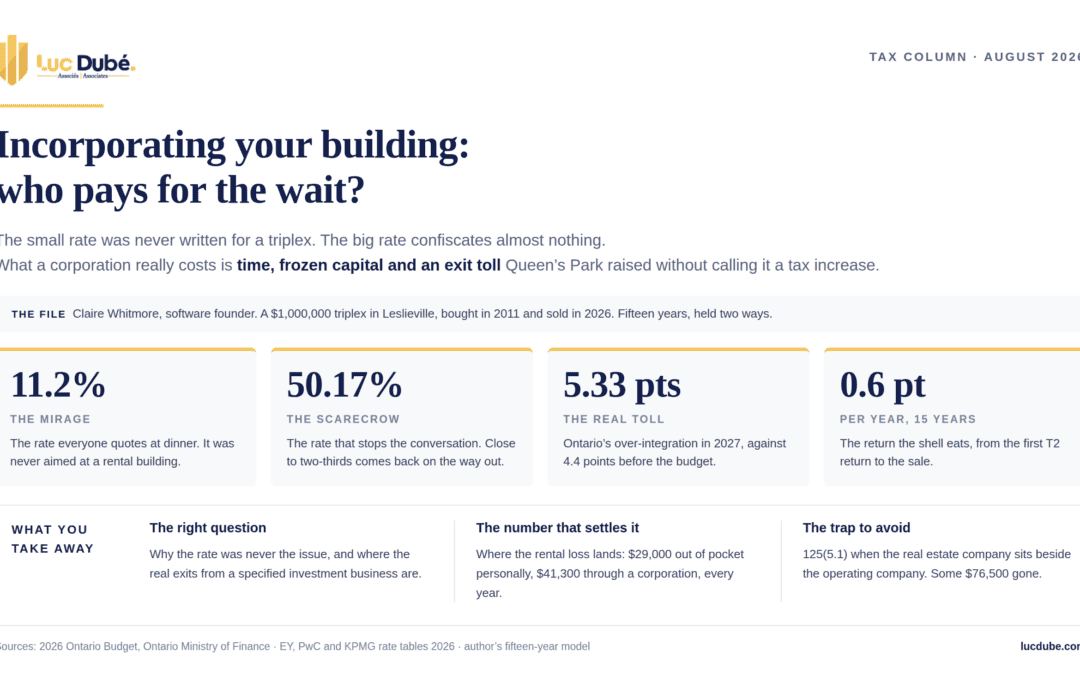
The low corporate rate was never written for a triplex. The highest corporate rate confiscates almost nothing. What a corporation really costs is time, frozen capital, and an exit toll Queen’s Park raised without ever calling it a tax increase.
It is always the same dinner. Somebody leans in between the main course and dessert and delivers the line: « Put that building in a corporation. » Nobody ever asks why. The advice makes the rounds like folklore, from brother-in-law to business lawyer, and lands on an accountant’s desk, where there are forty minutes to take apart twenty years of belief.
Claire Whitmore got that advice. Hers is an illustrative file, built on real Toronto parameters and a model I keep current: a software founder, a $1,000,000 triplex in Leslieville bought in 2011, $250,000 down, the balance borrowed at 4.5 percent, and $305,000 of capital genuinely on the table once closing costs and a cash reserve are counted. Toronto charges the land transfer tax twice: once to the province and once to the city. That is $32,950 gone before a single tenant writes a cheque. She listened. She incorporated. Fifteen years later, the numbers came in, and they tell a different story than the dinner did.
One thing first. This is about tax and nothing else. Asset protection exists, it has value, and I am not called to the bar. I stop there.
Eleven percent, and not for you
The fantasy has a number: 11.2 percent. This is what an Ontario corporation pays on income eligible for the small business deduction, and Queen’s Park has just sweetened it: the March budget cut the provincial slice from 3.2 percent to 2.2, pulling the combined charge below the old 12.2. Eleven percent, against a top personal rate of 53.53. You can see why people dream.
But that rate reaches exactly one thing: income from an active business carried on by the corporation. A landlord banking cheques on the first of the month is not carrying on a business in any sense the Act recognizes. Subsection 125(7) ITA defines a specified investment business as one « the principal purpose of which is to derive income from property, including interest, dividends, rents and royalties », and its main test is headcount: the company must employ « more than five full-time employees ». More than five. Six, year-round, on the payroll. Narrower doors exist: associated corporations, and revenue incidental to an active business.
Claire’s triplex employs nobody. That rate was never aimed at her. It reaches almost no owners of rental buildings in Ontario.
The fifty-percent scarecrow
So we run the numbers with the other one, the one that stops the conversation: 50.17 percent on the investment income of a private corporation in Ontario, being 38.67 federally and 11.50 provincially. Fifty point one seven. That shuts the brother-in-law up.
He is wrong about that too. Close to two-thirds of the bite never belongs to the taxman for good. Section 123.3 ITA stacks an additional refundable tax of 10⅔ percent onto a CCPC’s aggregate investment income, and subsection 129(4) ITA parks 30⅔ percent of it in non-eligible refundable dividend tax on hand. The money comes home: 38⅓ cents for every taxable dollar the company pays out, under subsection 129(1) ITA. It comes home, yes, but only if you drain the accounts. Nobody says that part out loud. Declare half of what you are owed and the rest sleeps in Ottawa. This is not confiscation. It is a deposit.
And on the way out, integration does its work with the regularity of a metronome. The untaxed half of the gain runs through the capital dividend account and leaves clean. The refundable balance empties. Fifteen years of accumulated losses finally get used. On a gain of $1,218,780, that account delivered $609,390 free of tax, and the refundable pot gave back $78,351. The corporate route ends with $1,684,601 in Claire’s hands, compared with $1,529,084 held personally.
So the shell won? No. Getting to that finish line cost a great deal more.
Where the loss lands is the whole question
This is where it gets decided, and nobody at that table has ever mentioned it.
Held personally, Claire’s triplex bled $22,100 in year one. A real loss. The rents on that building cover neither the interest nor the upkeep. The hole erased an equal slice of her software income, taxed at just under 45 percent, and the taxman handed back close to $9,800 the following spring. Her net outlay the first year: about $29,000. By year fifteen, it is $38,800, roughly a third more for the same building, because Ontario caps rent increases at about 1.8 percent a year while taxes, insurance, and repairs climb at 3 percent.
Inside the corporation, the identical loss piles up in a corner as a non-capital loss under section 111 ITA, carried forward against income the company has not earned yet and may never earn on the schedule its shareholder actually needs. It relieves nothing at all until she sells. Her first-year cheque climbs to $41,300. Twelve thousand dollars more, locked in a shell, earning nothing. Then add the accountant, the T2, the minute book: $2,500 a year, $37,500 over fifteen. Filing the Ontario annual return itself costs zero. Those are professionals, not government fees.
Now add up everything she put in, including the opening stake. Eight hundred and six thousand dollars held personally. Nine hundred and sixty-six thousand through the shell. A hundred and sixty thousand more, paid out in drips across a decade and a half, to pick up a hundred and fifty-six thousand extra at the wire.
Read those two figures again. She paid a hundred and sixty to collect a hundred and fifty-six. Across all the flows, the internal rate of return falls from 6.2 percent to 5.7.
Six tenths of a point a year. Paid fifteen years running. For a draw.
The toll just went up
And now the exit price rises, by political decision rather than market accident.
Ontario is trimming the dividend tax credit on non-eligible dividends from 2.9863 percent to 1.9863 of the grossed-up amount of anything « received or deemed received after December 31, 2026 », announced in the very budget that trumpeted the small business relief. The top personal rate on those dividends therefore climbs from 47.74 percent to 48.89. Not to 49.5, whatever your spreadsheet says: since 2014, the Ontario surtax is computed before the credit comes off, so the cut never gets multiplied. Quebec ran the same play in an April bulletin. Nova Scotia broke trail in 2025. Saskatchewan looked at the jump and refused it. The direction is uniform: relieve the operating business, load up whoever takes the surplus out.
The size of it is known. Investment income earned inside an Ontario CCPC and paid out to the shareholder carried 57.93 percent in 2026. In 2027 it carries 58.86, against 53.53 earned directly. Five point three three. That is what it costs a dollar to pass through a numbered company. Back in 2016, the national spread sat between 1.20 and 6.5 points. Today, it ranges from 2.09 in the Northwest Territories to 8.87 in Prince Edward Island.
Here is how it lands on a real transaction. Take an Ontario resident at the top rate sitting on a property with $1,000,000 of unrealized gain in 2027. Sell it herself and the bill is $267,650. Roll it into a company first under section 85 ITA, let the company sell, then pay the balance out as a capital dividend and a taxable one: the combined bill is $294,283. Twenty-six thousand six hundred dollars more. Two point six six percent of the gain evaporated in the detour, and before the land transfer tax, the roll-in triggers on its own.
The detour was never free. It just got more expensive.
Two lines on depreciation, then we move on
A word on capital cost allowance, that urban legend of investor dinners. It changed nothing here. There was no rental profit to shelter, and Regulation 1100(11) forbids CCA from creating or deepening a rental loss anyway. Having claimed none, Claire suffered no recapture under subsection 13(1) ITA when she sold. Depreciation inside a corporation deserves its own piece, with its schedules and its traps. It will get one.
When the corporation still wins
It happens, and it deserves to be said as plainly as the rest.
Take a building that throws off real net operating income instead of red ink, and leave it alone for twenty years without pulling out a dollar. There the deferral genuinely works for you, and Ontario offers the best of it in the country, 3.36 percentage points, the gap between the shareholder’s 53.53 and the company’s 50.17. A shareholder with no other income, to whom a rental deduction would be worthless anyway. A portfolio held with partners, an estate freeze to prepare, a succession to organize. The corporation finds its hour. Make sure the hour is yours.
And keep the real estate company separate from the operating company. Had the triplex slept under the same corporate roof as her software business, subsection 125(5.1) ITA would have woken up: adjusted aggregate investment income above $50,000 shaves the business limit by $5 for every $1, and kills it outright at $150,000. The sale would have wiped out the next year’s small business deduction. At the new rate, $76,500, gone because everything sat in one basket. Note the irony. The lower the small business rate goes, the more the deduction costs to lose. Last year, the same mistake cost $71,500.
What the shell actually takes
The corporation did not ruin Claire Whitmore. It slowed her down.
The low corporate rate was a mirage: rent is not a business. The big rate was a scarecrow: integration hands almost all of it back on the way out. The capital dividend account is no gift either. It is a refund of something that should never have been charged.
The real bill appears on no rate table. Twelve thousand dollars idled every spring. Thirty-seven thousand five hundred in fees. Fifteen T2 returns. A tax loss loitering fifteen years before it earns its keep. Six tenths of a point shaved off the return, year after year after year.
Then five points of over-integration are still waiting at the exit. They are not March’s doing. They were already there, at 4.4 points before the budget, and above 6 elsewhere in the country back in 2016. The budget adds a sliver, nine-tenths of a point. But it adds the sliver in the same breath as a tax cut, and inside a single document.
One hand gives. The other is already back in your pocket, a few pages on.
The brother-in-law was right about one thing. A corporation changes everything. Not in the direction he thought.