

This article is part of the Nomadic Tax service®; the structured pragmatism of international taxation.
We had left Montreal for Paris on one of those transatlantic flights that have become almost commonplace due to frequency. This density of connections between the two metropolises is not anecdotal: it reduces the marginal cost of travel, makes professional mobility more fluid, and already prepares the mind for one of the cardinal ideas of contemporary nomadism: a world where certain distances cease to be obstacles and become simple organizational variables.
We spent a few days in Paris, which, let’s be honest, is an “open-air museum”. Then came the last segment of the trip: Spain. Two weeks. Valencia, Barcelona, Madrid y Sevilla. Four cities, four urban temperaments, the same feeling of intensity. However, during the first few days, the experience was more physiological than aesthetic. The jet lag weighed heavily. Sleep was disorganized, the biological clock was unravelling, and fatigue, far from dissipating, seemed, on the contrary, to thicken to the rhythm of connections, airport halls, and suitcases dragged from one terminal to another.
When we arrived in Valencia after an extra flight, we were exhausted, with migraines, and almost dazed. We dropped off our luggage at the apartment and then chose, without much thought, a small neighborhood cafeteria — a kind of rallying point for the regulars of the area. Inside, the room was full. People were talking loudly, laughing, drinking, and eating sandwiches on a long, loaf-like bread reminiscent of the French baguette. The atmosphere seemed strangely festive for a Tuesday morning. Without thinking too much, I headed to the fridge, had two local beers, and then came back to sit down.
I opened one.
My wife looked at me and said, with surprise mixed with disbelief, “What exactly are you doing?”
I almost pushed her away with a distracted gesture. I was tired, out of place, still trapped in the travel fog. She did not insist: she herself was in a similar state. I started drinking this beer like you swallow an improvised remedy, hoping to soothe the headache a little. Then, reflexively, I took out my phone to check my emails. And that’s when I saw the time.
9:04 a.m…. ?!?!?
I froze. I was sitting with a beer in my hand in a crowded establishment where, obviously, no one thought it was absurd to consume alcohol at nine in the morning.
This scene, as light as it may seem, sums up perhaps the spirit of this article better than any statistic. Spain is, first of all, confusing because of its pace. For a North American, it often gives the impression of a country that lives out of step with the clock. In reality, it lives above all according to a different logic of time.

There is nothing folkloric about the explanation. It is historical, social, and institutional. Spain has a unique relationship with the daily schedule: later meals, stretched sociability, long evenings, the centrality of lunch, and the density of urban life at the end of the day. Added to this is a structural legacy that is rarely well understood outside Europe: Spain observes Central European time, although its geographic position would place it closer to the British time zone. This discrepancy between the clock and the sun pushes the social day towards the evening. At the same time, the organisation of work remains regulated, with an average of 40 hours per week per year, without imposing a uniform schedule, which allows the coexistence of continuous days and days cut according to the sector.
In other words, Spaniards do not necessarily work less: they work differently. For a long time, the country cultivated, and then modernized, a more flexible organization of the day, in which the centrality of the meal, the temperature, the economy of services, and the urban structure shaped the time lived. To an observer in a hurry, this may seem casual. For those who take the time to look, it is rather a question of another social grammar.
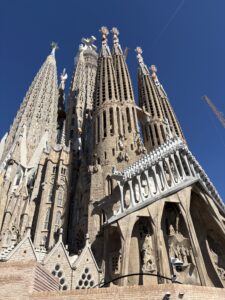
This grammar is part of a remarkably powerful setting. Spain doesn’t just offer a pleasant climate or a generous table. It proposes a density of civilization. Its territory juxtaposes Roman heritage, Gothic monumentality, Andalusian layers, Mudejar refinements, Baroque brilliance, and modernist audacity. Between the verticality of the cathedrals, the golden stone of the historic centres, the dense grid of the old quarters, the proximity of the Mediterranean beaches and the possibility, in a few hours, of going from a political capital to a port city or an Andalusian landscape, Spain gives the rare feeling of a country where beauty is not exceptional: it is distributed. The traveller accesses it with disconcerting ease.
This quality of life could lead one to believe that Spain is characterized by economic slackness. This is the classic mistake. The numbers tell a different story. Spain has emerged from 2024 and 2025 with real macroeconomic strength. Its growth has remained solid, and its resilience is no statistical mirage. The country is not in retreat; On the contrary, it remains in a phase of dynamic consolidation.
But the Spanish singularity appears above all when we observe the composition of this wealth. Spain is one of the world’s great tourist powers. Tourism accounts for a considerable share of gross domestic product and employment. This point is fundamental: a substantial fraction of Spanish domestic demand is, in reality, supplied by non-residents. A visible part of the Spanish lifestyle — in the streets, restaurants, squares, shops, and infrastructure — is supported by foreign consumption.

The contrast with Canada is striking in this respect. Tourism plays a real economic role, but it has much less structuring power. The Canadian economy is more reliant on other drivers: resources, finance, real estate, utilities, and domestic consumption. In Spain, on the other hand, tourism, hospitality, catering, transport, and cultural services constitute a more visible, more diffuse, and more intimately integrated foundation into the productive fabric.
This does not mean that Spaniards live in a hedonistic parenthesis financed by others. Rather, it means that their economy, which is more tertiarized and more closely linked to international flows of visitors, distributes its hours, income, and uses of the city differently. The result is a country that seems less tense, less rigid, and sometimes more open to life, without being free of the demands of work.
For the tax nomad, this is where the analysis becomes particularly interesting. The question is not only: can we live well in Spain? The real question is: how is the relationship among quality of life, taxation, and security articulated?
In terms of personal security, Spain offers a reassuring profile for a Canadian resident. It appears to be a stable, accessible, and generally safe jurisdiction for travel and settlement. This reality obviously does not exempt us from a concrete reading of the neighbourhoods, lifestyle habits, and ordinary precautions, but it clearly contributes to the country’s overall attractiveness.
On the tax front, Spain and Canada have two distinct philosophies.
In Spain, the personal income tax is based on a conceptually essential distinction between the general base and the savings base. Income from work, employment, pension, or rental is subject to the general base and is taxed according to a combined State + Autonomous Community scale, which means that the tax burden varies significantly from one region to another. Madrid remains relatively more lenient; Catalonia is much heavier. For very high work-related incomes, the combined marginal rate may approach particularly high levels, depending on the Community concerned. Capital income, on the other hand, is subject to a scale specific to the basis of savings, distinct from the general scale.
Canada, on the other hand, juxtaposes federal and provincial taxes. The crude comparison of the top marginal rates between some Canadian provinces and some Spanish regions can sometimes yield results that appear comparable. However, the overall logic differs. The Canadian system is characterized by partial integration of dividends, specific tax credits, and separate treatment of capital gains. In many cases, it can thus offer a more favourable reading of capital income and a relatively more tempered pressure on certain categories of middle-class taxpayers. The Spanish system, on the other hand, is distinguished by a much more marked regionalisation and by a clearer separation between ordinary income and income from property.
In other words, Spain is not a simplistic tax haven. It can become financially attractive in specific scenarios, but it requires a detailed analysis of the residence, the source of income, the asset structure, and, above all, the Autonomous Community concerned. It is precisely for this reason that it constitutes a privileged field of analysis in any serious reflection on fiscal nomadism.
The question then becomes not only theoretical but also practical: how to legally settle in Spain?
The first and classic route is the non-lucrative residence visa. It allows you to reside in Spain without carrying out a paid professional activity. It is therefore suitable for people with sufficient passive income or assets that allow them to live without working locally. It is not a work permit and does not authorize telework. Eligible family members can obtain it with the holder, but this route is not, in itself, a gateway to a professional activity in Spain.
The second way, which is now the most emblematic in the logic of international mobility, is that of the visa, or the authorization for international teleworking, commonly known as the digital nomad visa. It is aimed at third-country nationals who wish to reside in Spain while carrying out a professional activity remotely for companies located outside Spanish territory, using exclusively IT and telecommunications tools. This is where one of its major attractions lies: eligible family members, including the spouse or equivalent, can submit their applications jointly or later, and family authorizations expressly entitle them to reside and work in Spain, both as employees and as self-employed workers. For a married couple who wish to transfer not only their residence, but also their real economic capacity, this point is considerable.
There are also other paths depending on the profile: titles linked to skilled employment, intra-company mobility, family reunification, or even certain ordinary residence regimes under common migration law. On the other hand, one point must be clearly emphasised: the so-called investor visa route has been abolished for new applications. Any strategy that presents Spain as still open to the golden visa for real estate or similar would now be an outdated reading of the applicable law.
It is precisely here, in my opinion, that serious reflection on Spain begins.
Spain must not be fantasized or caricatured. It is neither a basic tax haven nor a backdrop for an extended vacation. It is a dense, legally structured country, fiscally demanding in places, culturally splendid, economically resilient, and humanly habitable. It offers something rare: the possibility of a high compromise between intensity of life, personal security, urban sophistication, and legal international mobility.
For some taxpayers, Canada will remain more efficient. For others, Spain will appear to be a more complete destination — not only because people eat late, walk better, or live outside more, but because it sometimes allows them to align, in the same space, the residence, the couple, remote work, the beauty of everyday life, and an intelligible fiscal architecture.
This is undoubtedly the real lesson of this beer taken at 9:04 in the morning in Valencia.
It wasn’t just jet lag.
It was a brutal and almost comical entry into another way of inhabiting time.