
Four profiles, one ranking, from Mexico to the Emirates. And a trap the expat videos always forget to mention.
Open any video app. Type « leave Canada, taxes ». You will hit the same promise a thousand times over, recited by a tanned young man in front of a pool: the taxman is bleeding you dry, just leave. Sun, zero tax, freedom. The camera never shows the bill.
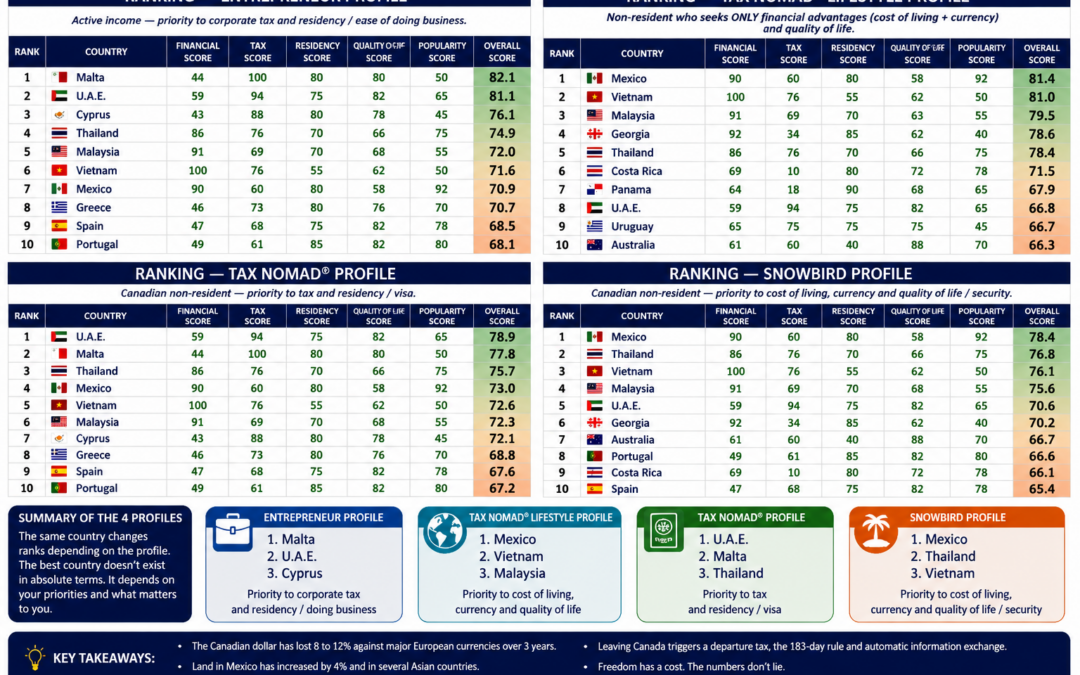
At Luc Dubé & Associates, we designed and modeled our own index, coldly, on the numbers. Cost of living, currency, taxation, quality of life, safety: five measures, some twenty countries, one single point of reference, Canada. And the numbers tell a story far more twisted than the one by the pool.
The dream sold on a loop
The promise rests on a premise nobody ever checks: that everyone flees for the same reason. Wrong. There is no single way to leave Canada. There are many; however, we will discuss four ways.
Four ways to leave
The snowbird, first. He winters in the sun but stays a Canadian tax resident. For him, tax does not move an inch: he pays Ottawa and Ontario whether he sits in Toronto or in Tulum. His only gain is the cost of living and the purchasing power of his dollar. Our snowbird ranking says it plainly: Mexico, Thailand, Vietnam, and Malaysia on top. Switzerland, dead last. The sun is not enough. It has to be cheap.
The Tax Nomad®, next. He breaks his residency, becomes a non-resident, and hunts for the lowest rate. The ranking flips at once: United Arab Emirates first, Malta second, Thailand third. The havens climb, lifted by the absence of personal tax and, for Malta, by a refund machinery that drags corporate tax down to roughly 5%.
The « lifestyle » nomad, third profile. A non-resident, too, but tax means nothing to him. He wants the best ratio between cost of living and quality of life, nothing else. And there the ranking turns inside out: Mexico, Vietnam, Malaysia, and Georgia take the lead, while the Emirates tumble to eighth. Too expensive. When tax stops counting, the air-conditioned desert loses its shine.
The entrepreneur, finally, who draws active income from a corporation. Malta, the Emirates, and Cyprus dominate. But look at the eleventh line of the ranking: Canada. Smack in the middle of the pack. Keep that detail handy.
The same country changes face from one profile to the next. The Emirates: first for the Tax Nomad®, eighth for the lifestyle nomad. Malta: second for one, fifteenth for the other. The right country does not exist in the absolute. It depends on who you are and what you are fleeing.
The shrinking loonie
Here is the heart of it. Over three years, the Canadian dollar lost nearly 12% against the Swiss franc, 10% against the pound, and 8% against the euro. The retiree dreaming of Portugal or Tuscany leaves with a shrunken loonie: a higher cost of living, and a weaker currency to pay it. The double penalty.
But the loonie did not melt everywhere. Against the Mexican peso, it gained 4%. The snowbird heading down to Mérida pockets the exact opposite: a life half as expensive, paid with a dollar that weighs more than before. The double bonus.
Europe punishes. Mexico rewards. The numbers have no feelings.
Corporate tax: the secret Canada keeps badly
That leaves the knockout argument of the videos: corporate tax. And here, surprise. With its small-business rate of 12.2%, Canada crushes nearly every destination in our index. Only the United Arab Emirates, at 9%, and Malta, thanks to its refund, do better. Cyprus trails at 12.5%. Everyone else, France at 36%, Australia and Mexico at 30%, the United States at 26%, taxes the corporation more heavily than Ottawa.
That is precisely why Canada lands eleventh among entrepreneurs, not last. In terms of active business income, it holds its own. The entrepreneur who packs his bags « for the corporate tax » is most often chasing a mirage. What truly pushes him out is not the rate. It is the cost of living, the climate, and the fatigue. Not the tax column.
The exit door is booby-trapped
And then there is what the pool never films. Leaving Canada is not the same as closing an app. It is walking through a door locked three times over.
Departure tax: the moment you stop being a resident, the taxman acts as if you had sold almost everything you own, shares, investments, corporate holdings, and taxes the accrued gains on the spot. The 183-day rule: the snowbird who lingers too long becomes a deemed resident again, no matter the address on his postcard. Automatic exchange of information: since 2018, Canada has received details of your foreign accounts from a hundred-odd countries every year. The double non-residence, the one where nobody taxes you anymore, has all but vanished.
Departure tax, the 183-day rule, automatic reporting: three locks the video forgets, every single time, to film.
Leaving remains a privilege
In the end, the index does not shout « run ». It says « do the math ». The snowbird wins in Mexico. So does the nomad who shrugs at tax. The tax-haven hunter finds his account in the Emirates or in Malta. The entrepreneur would do well to reread the corporate column before booking his flight.
But there is something harder than all of that. To rank the countries, you first have to be able to choose. Moving your life, triggering the departure tax, paying a tax specialist to open the right door: all of it takes assets, capital, room to maneuver.