
Scams, corruption, captured institutions: the « blame the farang » story hides them all, and shields an elite that clings to power because it never intends to pay for anything.
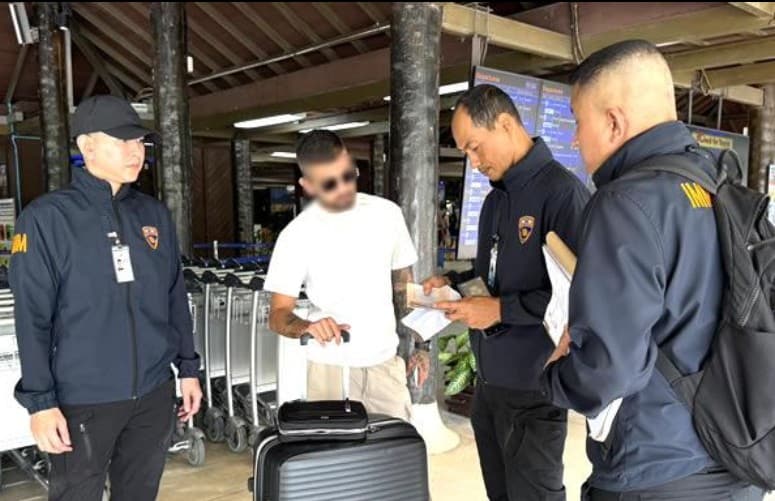
On the islands, the raids come at dawn. Officers walk into a beachfront café on Koh Phangan, a dive shop on Phuket, a villa on Koh Samui, and they leave with foreigners in handcuffs and land under seizure. The cameras are invited. The message is broadcast in the loyalist press within hours: the foreigner problem has gone too far, and the state is finally and decisively taking it back. Twenty-two foreigners cuffed in a single second-phase sweep on one island. More than forty rai of land seized, worth over two hundred million baht. Israelis named, Indians named, the villains helpfully rotated week by week so the story never goes stale.
Watch it from a distance, and you would assume these people did something drastic to deserve it. They did not. The foreigner in Thailand today is doing exactly what foreigners have done for fifty years. Renting the condo. Running the bar. Filing the reports, showing up at immigration on the day he is told, buying the house through the company structure a Bangkok law firm sold him as the legitimate path. Nothing about the foreigner changed. What changed is the country he is standing in, and the men who run it needed the cameras pointed at somebody.
They pointed them at him.
The magic trick
Here is the thing about a magic trick. The whole art is in the hand that moves so the audience looks away from the hand that matters. Thailand’s political and business class has been performing this trick for a generation, and in 2026 it is doing so at full volume because the hand it needs you not to watch is buried in concrete and mortgage paper.
The foreigner is the decoy. The theft is the property market.
Not the beach scams, not the tuk-tuk hustle, not the jet-ski shakedown, the small stuff every tourist board pretends is the whole of Thai dishonesty. The real machine is bigger, quieter, and entirely domestic. It runs on empty houses, frozen valuations, banks that will not book a loss, and a cluster of dynastic families who take land the way other people take a parking space. The foreigner losing his villa on Phuket is the visible enemy. The families sitting on thousands of rai of stolen state land are the invisible ones. Only one of them makes the news.
The city with the lights off
Start with a number so large that most people refuse it at first. Thailand has 1.64 million finished homes standing empty. Not between tenants, not for sale, empty and dark. The Thai Real Estate Research and Valuation Center put the value of that idle concrete at roughly 3.45 trillion baht, about 109 billion US dollars. That figure is not a rounding error in the national accounts. It is nearly the size of the Thai state’s entire annual budget.
More than 730,000 of those empty units sit in Bangkok alone, close to half the national total. In the condominium segment, nearly one in four is vacant. Drive the sois off Sukhumvit at night and count the dark balconies, floor after floor, no laundry, no light, no life, sold as investments to people who were promised a yield that the actual market never paid.
An entire national budget’s worth of housing, built for buyers who are never coming. That is not a market. That is a monument to a lie that nobody in charge will let fall.
The banks that refuse to blink
A functioning market has one honest reflex. When nobody wants a thing, the price comes down until somebody does. Thailand has trained that reflex out of its property sector.
Look at what the data does instead. Home foreclosures exploded. In the second quarter of 2025 alone, seized residential properties listed for auction totaled 67,600 units, a 210 percent increase in a single year, according to the state planning agency. Household non-performing loans climbed to 1.24 trillion baht, 9.11 percent of all household credit and rising across every category. Mortgage rejection rates reached roughly 80 percent, up from about 30 percent during the pandemic, so a whole generation of buyers is locked out at the exact moment the inventory is drowning. Household debt sits above 16 trillion baht, near 87 percent of GDP, the heaviest load in Southeast Asia and among the highest on earth.
And at the top, the building never stops. Luxury stock, homes above 10 million baht, roughly tripled from about 12,000 units in 2019 to nearly 38,000, even as new housing sales collapsed 49 percent in the first half of 2025. In the 25-to-50-million-baht bracket, there are around 3,000 unsold houses, five to six years of supply. The developers kept building for a middle class that was told to keep growing and did not.
Yet the asking prices barely move. Why? Because a real price would be a confession. If one bank sold one repossessed muban house for what it is truly worth, every comparable house in the country would have to be marked down to match, and the shared fiction propping up the balance sheets would crack. So the banks hold the concrete and refuse to blink. A property consultant put the quiet part on the record: repossessed collateral, he admitted, rarely covers the full value of the loan once the bank takes it, and forced bulk sales go at steep discounts. Which means the Thai family does not simply lose the house. The bank eats a shortfall; it will do anything to avoid crystallizing it, and a Bank of Thailand study found that a third of foreclosed borrowers stay trapped in debt even after the asset is gone.
The family loses the home, loses the savings, and the debt does not always die with the house. Empty condos, frozen foreclosures, mortgages nobody can get, valuations nobody will cut: the whole apparatus runs on a single refusal to let anyone find out what anything is actually worth. The foreigner did not build that. He is not even allowed to own the land it sits on.
The tenants are keeping the lights on.
Here is the detail that finishes the argument, and it is the opposite of what you would guess. While the ownership market rots, the rental market is on fire. Grade A apartment rents in Bangkok rose about 6.5 percent in a year, high-end and luxury rents more than 8 percent, and prime condominium rents as much as 15.9 percent. The demand is there. Expatriates returning, digital nomads arriving, and Thais themselves, shut out of mortgages, are instead giving up on buying and renting.
So the problem was never that nobody wants to live in Thailand. People want in. The problem is an ownership market priced at a number the buyer cannot reach and the bank will not cut, sitting atop a rental market that works fine. And the foreigner the state is now busy expelling is, in case after case, the tenant keeping that rental market alive. The country is throwing out its paying customers to distract from the fact that it cannot house its own.
Who actually steals the land
Now watch the hand nobody films.
In May 2025, the Criminal Court for Corruption and Misconduct sentenced Prayudh Mahagitsiri to 24 years in prison. He is a coffee and steel magnate, valued by Forbes at somewhere between 1.4 and 2.6 billion dollars depending on the day, long counted among the richest men in the country. His crime, as the court found it, was colluding with land officials to fraudulently expand his Mountain Creek Golf Resort by 189 rai into protected forest reserve and into « Sor Por Kor » land, the category the state sets aside by law for its poorest and most landless farmers. His daughter drew twelve years. A land officer drew forty-two. He is out on one million baht bail. He is appealing.
A golf course for the very rich, built on the soil reserved for the very poor. That is the shape of Thai land justice at the top.
At the bottom, it looks like Porlajee Rakchongcharoen, the Karen activist everyone knew as Billy. He fought the eviction and burning of Karen homes inside Kaeng Krachan National Park, and helped the families sue the park chief, Chaiwat Limlikit-aksorn. On 17 April 2014, traveling to help prepare that case, he was detained by Chaiwat’s men at a park checkpoint over a jar of wild honey. He was never seen alive again. When the hearing came weeks later, villagers testified in his place. Five years on, divers found bone fragments in an oil drum sunk in a park reservoir; DNA matched his mother. In September 2023, the court acquitted all four officers of murder, citing insufficient evidence, and convicted Chaiwat only of failing to report the arrest. Three years. His subordinates walked because, the court reasoned, they were following orders. Chaiwat was not fired. He was already running the country’s national parks office, 155 parks under his authority. His widow told VOA that the courts in Thailand are not very fair.
And here is the coda. In June 2025, Chaiwat was finally dismissed. Not for Billy. For separate corruption, bid-rigging and kickbacks during his years running Kaeng Krachan, the very years Billy vanished, with the dismissal backdated to 2023. Read the sequence slowly. A man is accused of burning Karen homes. The activist who fights him disappears. The man is acquitted of murder and left in charge of the nation’s parks. And the thing that finally ends his career is a financial-crime file, not a body. In Thailand, they will eventually get you for the money. Almost never for the man.
The five thousand rai nobody will return.
If you want the purest specimen, go to Buri Ram.
There are 5,083 rai of land at Khao Kradong, reserved for the State Railway of Thailand by royal decree back in 1919. The Supreme Court ruled it belongs to the railway in 2017 and again in 2018. The Appeal Court affirmed. The Central Administrative Court ordered the deeds revoked. Four rulings, one answer. And the land has not been returned.
Why not? Because a chunk of it is occupied by the Chidchob family and their companies, the founding dynasty of the Bhumjaithai Party, the party that now runs Thailand. Their holdings there include the Chang Arena football stadium and the Chang International Circuit, the track that has hosted the Thailand MotoGP since 2018. The Department of Lands, under the Interior Ministry, repeatedly declined to revoke the titles; its own committee ruled against revocation in 2024, and when the ministry finally ordered the land reclaimed in August 2025, the department stalled again within weeks. Newin Chidchob is the party’s de facto leader. His son Chaichanok is its secretary-general and a cabinet minister. And the man at the very top, Prime Minister Anutin Charnvirakul, is himself the subject of an ethics petition over his failure to enforce those rulings. Anutin, for the record, is no outsider to the world he now polices: his family owns Sino-Thai Engineering and Construction, one of the kingdom’s great construction houses, a builder of Suvarnabhumi Airport itself. The man lecturing the foreigner about respecting Thai law is a construction-dynasty heir whose closest allies sit on state land four rulings ordered returned.
It gets more instructive. In January 2024, the Constitutional Court ruled 7 to 1 that Saksayam Chidchob, then transport minister and brother of Newin, had concealed his ownership of a construction firm that won more than a billion baht in contracts from his own ministry. Clear ruling, highest court, removed from office. Then, in 2026, the National Anti-Corruption Commission reviewed the same facts and found no deliberate concealment, contradicting the court that outranks it. A former commissioner of that very agency, Vicha Mahakhun, said the quiet part aloud: the anti-graft body exists to investigate corruption and send cases to the courts, not to overrule them.
That is the machine. When the powerful are caught, the ruling is buried, slow-walked, or quietly reversed. When the land is theirs, the court order simply never arrives.
The convenient foreigner
So now, put both hands side by side and watch the trick in full.
Since October 2025, the Department of Business Development has run an AI system that cross-references company records against tax, land, and immigration databases to hunt « nominee » structures, the Thai-majority companies through which foreigners have long held land. It has flagged roughly 47,000 companies. The raids followed: arrests, frozen titles, and, under Section 94 of the Land Code, forced sale of the land within a year. Deportation and a lifetime blacklist come on top, through the immigration and criminal codes. On the islands and in Pattaya, the foreigner who ran a real business paying real Thai wages is being cleared out.
Here is the part the crackdown coverage skips. That structure was not a back-alley dodge. It was the standard product, sold by respectable Bangkok law firms with English-language websites, registered with the same Thai government that is now criminalizing it, and processed for two decades without a murmur. The foreigner did what his qualified Thai lawyer told him to do. And when the flag arrives, the lawyer who drafted it and pocketed the fee is nowhere to be found. The foreigner loses everything. The lawyer keeps the fee.
Then do the arithmetic the coverage never does. Roughly 47,000 companies flagged. About 850 charged. An enforcement rate near 1.8 percent. Now set that beside the Chidchob land at Khao Kradong: three courts, four rulings, and an enforcement rate of zero. The state pursues the foreigner at almost two percent, and pursues the ruling family’s occupation of public land at nothing at all. Two percent is not much. But two percent is infinitely more than zero.
And when the foreigner’s land is forced onto the market, ask where it lands. Not with the public. It flows, at fire-sale prices, toward the domestic holding companies with the political cover to absorb it, the same families the crackdown was never going to touch. The land does not get liberated. It gets transferred, from the foreigner who ran a business to the elite that runs the country.
Meanwhile, the visible show goes on. Nearly 29,490 foreigners were refused entry in the first five months of 2026 under a campaign the Immigration Bureau brands the « Three No’s ». India, Thailand’s third-largest tourist market, was recently dropped from the visa-free list to a 15-day visa-on-arrival. Banks have been freezing and closing foreigners’ accounts and tightening the criteria for opening one. Every announcement lands, reliably, in a bad week for the government: a fresh corruption headline, a grim growth forecast, a debt figure nobody wants on the front page.
The foreigner is not the disease. He is the anesthetic.
Look at the country the trick is meant to hide. Growth crawling at 1.6 percent, the weakest in three decades outside a crisis year. As a total economy, Vietnam is on track to overtake outright by the end of this decade. Household debt near the top of the world league, its citizens spending more than a fifth of their income just to service it. An entire national budget frozen in empty houses. Courts that rule and rulings that vanish. A ruling family sitting on state land while a billionaire’s golf course sits on the soil of the poor.
None of that is the foreigner’s doing. He never had that kind of reach.
If you are in Thailand right now and you feel the country has turned on you, understand what has actually happened. The country has not turned on you. Its political and business classes have turned on their own people, run out of ways to hide it, and decided your face is the most convenient one to put in front of the cameras while the real damage is done in the land offices and the bank ledgers.
You were never the problem. You were the diversion.
And the men who built the thing that needs a diversion are still in their offices, still drawing their salaries, still praised by the loyal press for taking a firm line on foreigners, still hoping the next visa headline holds the news cycle for one more week. Long enough that nobody looks at the hand that matters.
Sources. Thai Real Estate Research and Valuation Centre and Nation Thailand (vacant-housing stock and value, luxury oversupply); National Economic and Social Development Council and the Real Estate Information Center (the 2025 foreclosure surge, household NPLs, and the study on post-auction deficiency debt); Cushman & Wakefield Thailand (mortgage rejection rate and the collateral shortfall); CBRE, JLL and The Realtors (rising Bangkok rents); Knight Frank (luxury supply growth and the sales collapse); World Bank, KKP Research and Bank of Thailand (growth, household debt, debt-service burden); World Bank, OECD and AMRO (the 1.6% growth consensus); Central Criminal Court for Corruption and Misconduct, Forbes and Nation Thailand (Prayudh Mahagitsiri); Bangkok Post, VOA, BenarNews and ICJ (the Porlajee « Billy » Rakchongcharoen case and Chaiwat’s later dismissal for separate corruption); Bangkok Post, Nation Thailand and Thai Examiner (Khao Kradong and the State Railway rulings); Bangkok Post, The Nation and Thairath (the Saksayam Chidchob rulings, the NACC reversal, and Vicha Mahakhun’s criticism); Department of Business Development reporting via Nation Thailand, Bangkok Post and Pattaya Mail (the nominee crackdown and enforcement figures); Immigration Bureau via official Public Relations Department figures (entry denials, the visa rollback). Dates and figures current to mid-2026.