
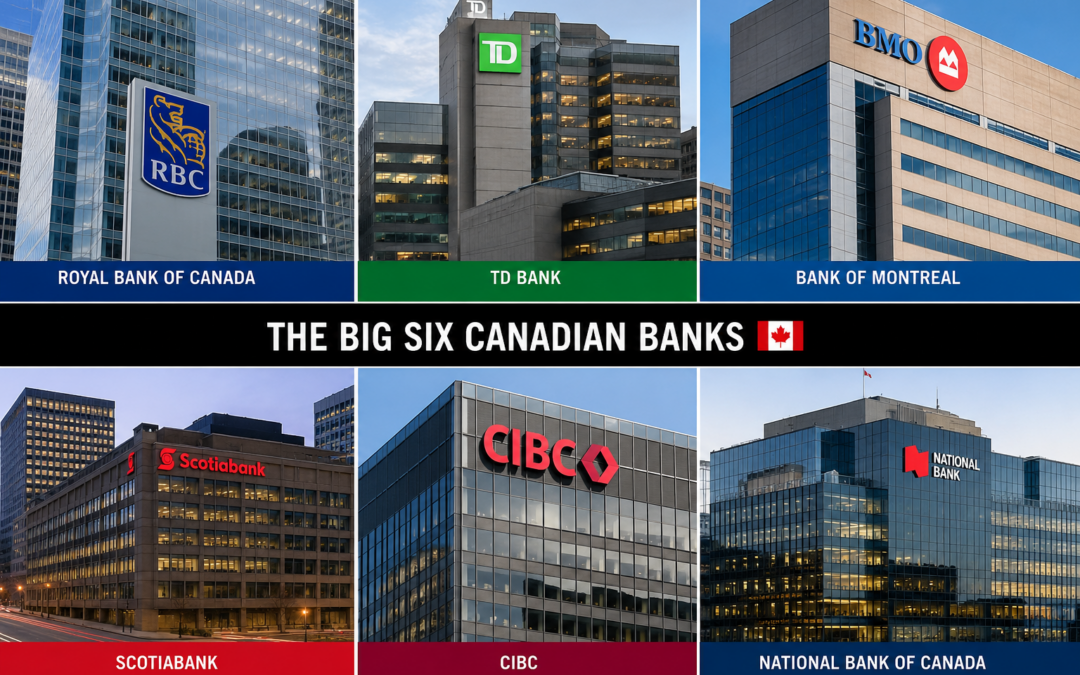
How an oligopoly built and shielded by Ottawa shipped its profits to the United States while Canadian factories closed and its own workforce was cut.
Sylvain’s paradox
Sylvain runs a hardware store in Victoriaville. When the tariff wars hit this spring, he swapped half his American suppliers for Canadian ones, eating a margin his Quebec supplier could not match. He kept going.
He put an « Achetez d’ici » sign in the window and told every customer that every dollar spent here stays here. In a town of seventeen thousand, that faith is the mortar.
Each morning, he drives his deposit to the same branch his father used. The bank is Canadian; its ads are full of wheat fields and cottage docks. He assumes the money feeds a pool reinvested at home: a Sherbrooke loan, a Trois-Rivières mortgage.
He is wrong.
His bank did the opposite. It shipped billions south, to Ohio, California, Texas, and Arizona, the market the Carney government now begs the country to flee. It left in the open: filings, press releases, investor days. They called it « North American growth strategy », never « leaving Canada ».
Sylvain keeps his end. His bank does not. No conspiracy here, just a reading of their own filings.
Capital votes, and it votes south
In February 2023, BMO bought Bank of the West of San Francisco for US$16.3 billion: 1.8 million customers, 500 branches, overnight. CEO Darryl White called it « the natural next step in BMO’s North American growth strategy ». The US division accounts for 40 percent of earnings, and on its second-quarter 2026 call, it told investors that US return on equity should climb from 8 to 12 percent by 2028.
Scotiabank closed a 14.9 percent stake in Cleveland’s KeyCorp on December 27, 2024, for roughly US$2.8 billion. CEO Scott Thomson said capital was moving « from developing markets to developed markets in North America ». The bank called it « cost-effective, low-risk ». Its international banking earned $12.043 billion in 2025, nearly matching the $13.425 billion earned at home.
Royal Bank tells the same story in one segment. RBC Capital Markets now draws about half its revenue from the United States, against roughly 30 percent at home, though the bank as a whole still earns most of its money in Canada. City National, its US bank, booked US$7.023 billion, and US assets under administration reached $1.083 trillion.
Then TD, whose US ambitions were kneecapped by a US$3.1 billion money-laundering fine and an asset cap from American regulators. In 2025, it dumped its roughly US$14 billion Charles Schwab stake, then cut two thousand jobs, 2 percent of its workforce. The American bet failed, so Canadian workers paid.
Statistics Canada recorded a net portfolio capital outflow in the second quarter of 2025 as investors piled into US securities. The banks lead the current, not fight it.
Record profits, shredded jobs
Record profits on one side of the ledger, layoff notices on the other. The Big Six booked roughly $70 billion in fiscal 2025, up from about $51 billion the year before. Seventy billion, pulled from a country of forty million, in a year, the same banks shed Canadian workers.
Royal Bank crossed a line no Canadian bank had reached: $20.369 billion in profit. CEO Dave McKay called Canada a « K-shaped economy », the wealthy riding asset markets while households drown in rent and groceries. Scotiabank cut about three thousand positions and took a $373 million restructuring charge. TD cut two thousand. RBC laid off in spring 2025, McKay explaining it had « hired thousands too many ». As if the workers were an inventory error.
Set that against the country. Unemployment hit 7.1 percent in August and September 2025, the highest since 2016 outside the pandemic. August alone shed 66,000 jobs; manufacturing is down 58,000 from its January peak. The pain has postal codes: Windsor at 11.1 percent, Oshawa at 9.0 percent, and Toronto at 8.9 percent. Algoma Steel in Sault Ste. Marie issued a thousand layoff notices, crushed by tariffs. The current account deficit hit a record $21.2 billion.
The banks in Ottawa posted records the same year a steel town told a thousand workers not to come back.
The broken contract
Canada did not stumble into a banking oligopoly. It was built under federal law. The Bank Act disperses ownership, caps stakes, and holds foreign rivals at the gate. In the late 1990s, the Chrétien government blocked Big Six mergers that would have shrunk the field to three. Six banks now control more than 90 percent of the market and about 93 percent of banking assets.
The bargain was never written, but every finance minister and bank chief understood it: protection and a public backstop, in exchange for service to the real economy. When 2008 hit, the public held the net. The Canadian Center for Policy Alternatives put federal and central-bank support at up to $114 billion, including $69 billion in CMHC mortgage purchases. The taxpayer was the lender of last resort, and the obligation ran one way.
The banks kept all the benefits and shed the duty. Still 90 percent share, still the « too-big-to-fail subsidy » that lets them borrow cheaper than rivals without it. But « Canadianness » was never a covenant, only a brand. No law requires reinvesting Canadian profit at home; none sets a floor on Canadian jobs. Ottawa built the fence and forgot the conditions.
The banks are not villains. They behave as the rules reward them: a protected market hands them cash flow no rival can undercut, spent abroad where returns run higher. Executives answer to shareholders; a bank passing up a 12 percent US return for a 7 percent home one would be sued, rightly. A privilege without a counter-obligation is not a contract. It is a rent. They did not break a law. They exposed a design flaw.
The pension funds echo
If this were only about banks, the fix would be easier. It is not. Canadians pay into the Canada Pension Plan with every cheque. Where Canadian households keep more than 80 percent of their financial assets at home, the fund built from their contributions does the reverse: by the Fraser Institute’s count, 83.5 percent of its assets sat abroad, and by CPP Investments’ own figures only about 14 percent stays in Canada, a share that keeps shrinking. The Ontario Teachers’ plan is barely better, near 36 percent at home. Retirement savings taken from workers by statute finance highways in Mexico, rail in Europe, and office towers in Sydney, while Canadians ask why nothing gets built here.
No scandal in it: managers follow their mandates, and nowhere does the word « Canada » appear. Ottawa has spent months urging the funds to think again, and has answered with structures: the $25 billion Canada Strong Fund, a Major Projects Office, the scrapping of the 30 percent cap on pension investment in Canadian private firms. And forget the idea that pension funds « own » the banks: the dispersed-ownership rule means Ontario Teachers’ holds just 0.14 percent of TD.
The lobby that writes the rules
How does a sector hold this much power while delivering so little? Three levers. Expertise: when Ottawa drafts banking law, the only people who can parse capital ratios or mortgage securitization are the banks, who shape the words. Weight: hold the mortgages on millions of homes and the rails moving the country’s money, and no government can ignore you. Access: the Canadian Bankers Association is a fixture in Ottawa, its contacts logged in the Lobbyists Registry.
These are not briefcases in parking garages. When OSFI proposed the B-20 mortgage stress test in 2017, the CBA pushed for flexibility, warning of tighter credit; the final 2018 rules came out softer. The pattern repeated in 2023: OSFI moved to tighten mortgage capital rules, and the phase-in was stretched. Rarely a full reversal. Almost always a softened policy, dressed as technical consultation.
CBC News found 581 contacts between officials and the banks or the CBA in the eighteen months after the 2015 election. The CBA filed 159 reports on its own, two a week, the most active lobby in the registry. A small-business federation writes a submission. The CBA writes the paragraph that becomes the regulation. Both are heard. One is obeyed.
Ottawa’s move
Capital has no homeland. It has returns. Asking a bank to stay Canadian out of patriotism is shouting into the wind. The only thing that binds money is law. Pass a patriotism motion, and every bank applauds; none of it forces a dollar to stay where the return is thinner.
Ottawa half-grasps this on pensions: killing the 30 percent cap and setting up the Canada Strong Fund admit that capital comes home only when you build structures to pull it. On the banks, it looks away. No duty to reinvest record profits at home. No mandatory fraud reimbursement, though the model sits in plain sight: since October 2024, the United Kingdom has required banks to repay fraud victims up to £85,000 within five business days. Canada has no equivalent, and no challenge to a 90 percent concentration that pushes capital south.
Your six big banks do not hate Canada. They calculated that it no longer pays enough and voted with the only ballot that counts for them: their capital. It points south. The next time a bank ad shows you wheat fields and a family on a cottage dock, remember what it did with its money when nobody was asking.
Sylvain still drives his deposit to the same branch every morning. The bank still ships it south. Only one of them has a choice. It is not Sylvain. The question is whether anyone in Ottawa will finally attach a condition to the privilege. The fence was built decades ago. The terms were never written. Until someone writes them, the ads will keep showing you wheat fields, and the capital will keep its passport.
Sylvain keeps his end of the bargain every morning. No one has ever asked the banks to keep theirs.