

Ontario law will let you buy him out. The Income Tax Act then taxes whoever is left standing alone. Here is how to show a partner the door without ever becoming the last one in the room.
By Luc Dubé, M. Tax., Taxation Expert
For the record: I am not a member of the Law Society of Ontario. I am a Taxation Expert, and I now work alongside legal professionals trained in Ontario’s common law. What follows is the tax side of a legal problem, written with their half of the file in plain view.
Graham runs the trucks. For eleven years, he and Trevor have split a landscaping and snow-removal partnership north of Toronto straight down the middle: half the profits each, half the draws each, and nowhere near half the work each. When the snow comes, Graham is on site at five in the morning. Trevor picks up his phone when it suits him and cashes the same cheque. Last spring, Graham stopped complaining and started negotiating. A term sheet was signed. A closing date was set.
Graham and Trevor are composites. The file behind them is real, stripped of every detail that could point to a client. On the day I opened it, the deal on the table was a poisoned chalice: a six-figure capital gain for the privilege of keeping his own business.
Nobody had done anything wrong. That is why the story deserves telling.
You cannot fire a partner
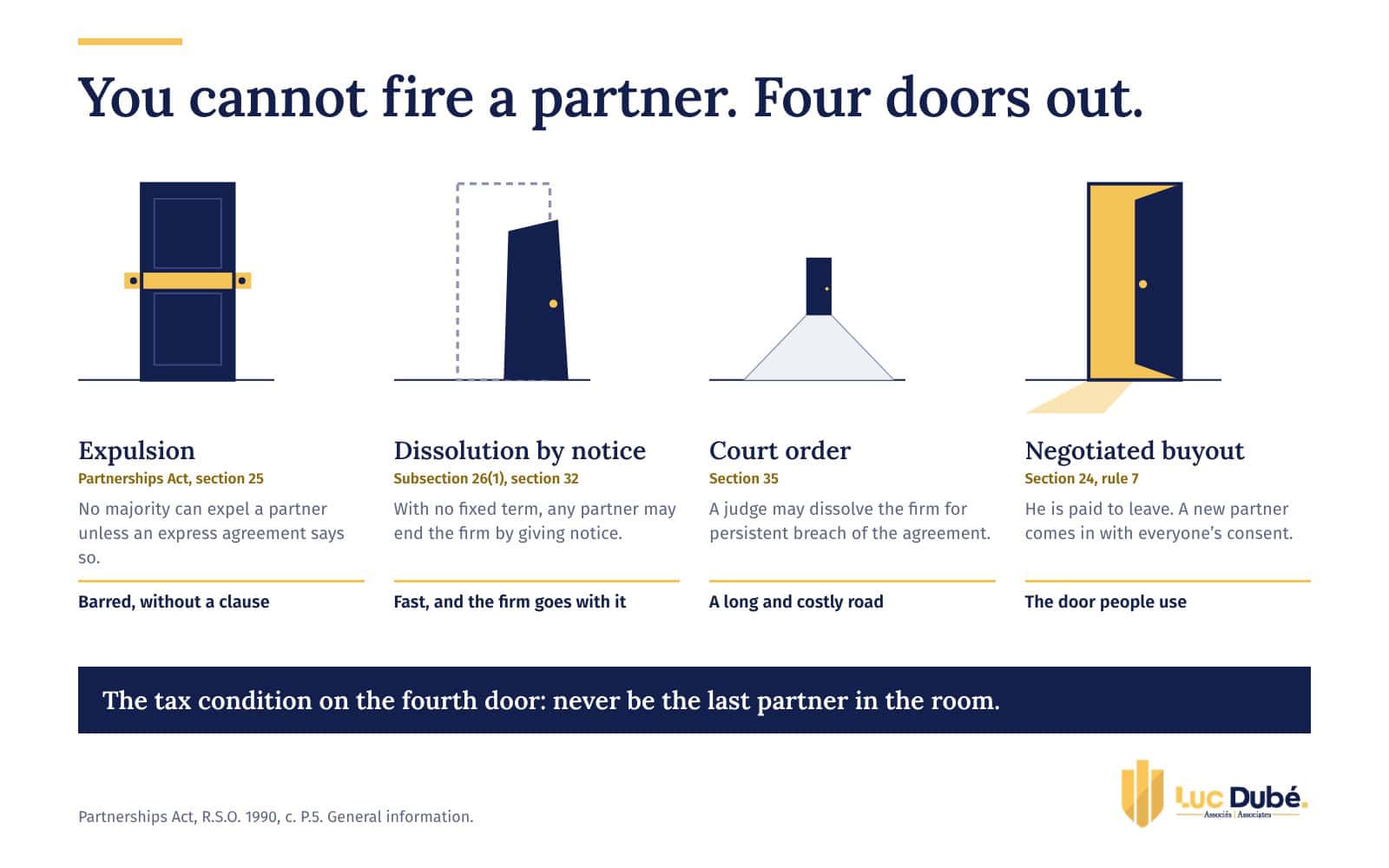
Right off the bat, a disappointment. A partnership has no board, no shareholders’ vote, no termination letter. Section 25 of Ontario’s Partnerships Act says so in one sentence: « No majority of the partners can expel any partner unless a power to do so has been conferred by express agreement between the partners. » Two partners, no expulsion clause: nobody can throw anybody out. And where such a clause exists, expelling one partner out of two still leaves one, which is exactly the situation the Income Tax Act punishes.
Three doors remain. The first is dissolution. Where no fixed term was agreed, subsection 26(1) of the Partnerships Act lets any partner end the firm by giving notice to the others. Quick, and destructive: the business is wound up, and the tax trap described below springs all the same.
The second door leads to the courthouse. Under section 35, a judge may order dissolution when a partner « wilfully or persistently commits a breach of the partnership agreement », or behaves in such a way that carrying on business with him is no longer reasonably practicable. Whoever helps himself also owes the firm a reckoning. Sections 28 to 30 require true accounts and full information, the surrender of any benefit drawn without consent from the firm’s property, name or business connection, and the handing over of profits earned in a competing business. Real remedies. Slow ones, too, and costly.
The third door is the one people actually use: you pay him to leave. A negotiated buyout, on terms both sides can sign, is the legal way to get rid of a partner in Ontario. Graham had found that door on his own.
He was about to walk through it the wrong way.
The last partner standing pays
Graham had recently incorporated a company of which he is the sole shareholder, and he wanted the business to live there. The plan looked simple. Trevor leaves, the partnership ends, Graham carries on.
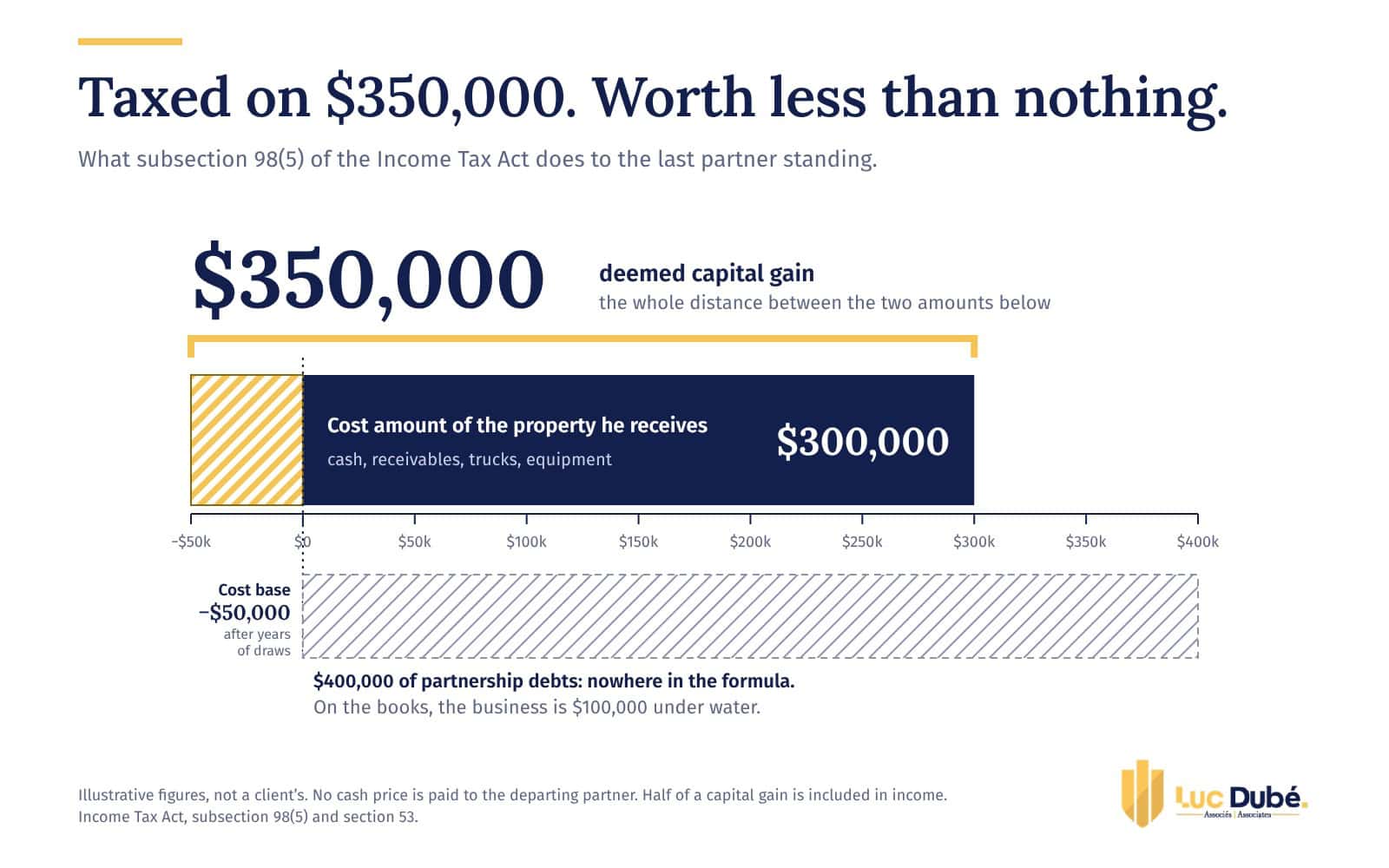
Enter subsection 98(5) of the Income Tax Act. It applies where a Canadian partnership « has ceased to exist » and, within three months, a single former member « carries on alone the business that was the business of the partnership ». That person is deemed to have disposed of the partnership interest. For what proceeds? The greater of two amounts: the adjusted cost base of the interest, or the cost amount of the partnership property received, cash included.
Read the formula twice. The partnership’s debts appear nowhere in it.
Now for some numbers, which are illustrative and not the client’s. Suppose the partnership holds cash, receivables, trucks and equipment with a cost amount of $300,000, and owes $400,000, a good part of it to the tax authorities. On its books, the business is $100,000 under water. Suppose each partner’s adjusted cost base has sunk to minus $50,000, and that Trevor is paid no cash price: he leaves against an indemnity for the debts. Graham’s deemed gain comes to $350,000, half of it taxable in his hands, with alternative minimum tax to be checked on top, since capital gains now enter its base in full. Had Graham personally paid a price for Trevor’s interest, paragraph 98(5)(g) would add that price to his cost base and trim the gain by the same amount.
Why is the cost base below zero? Not because of the calendar. When a partnership ceases to exist, subsection 99(1) of the Income Tax Act ends its fiscal period just before, so the current year’s income enters the cost base under subparagraph 53(1)(e)(i) ahead of the calculation. The cause is older and plainer: years of draws, deducted under subparagraph 53(2)(c)(v), that exceeded the income allocated to the partners. Money taken out that the business had not earned is money the business borrowed. With the books in balance, the gain tracks the debts. Graham is taxed, in effect, on what the firm owes.
Worse still, the obvious remedy cures nothing. Cutting the draws before closing leaves the gain intact: every dollar left in the firm raises the cash Graham receives by exactly the dollar it spares his cost base. Only paying down a debt narrows the gap, since the cash goes out and the cost base does not move.
And the safety net? Subsection 98(6) of the Income Tax Act treats a new partnership as the continuation of the old one, provided its only members « were members of the predecessor partnership ». Graham’s corporation never was.
The price is innocent. The timing is guilty.
The crux of the matter fits in a single line: for the partner who stays, the buyout price creates no tax, and the instant at which only one partner remains creates all of it. (The partner who leaves has his own reckoning: a gain on his interest, to which subsection 100(2) of the Income Tax Act adds any negative cost base.)
So that instant must never arrive.
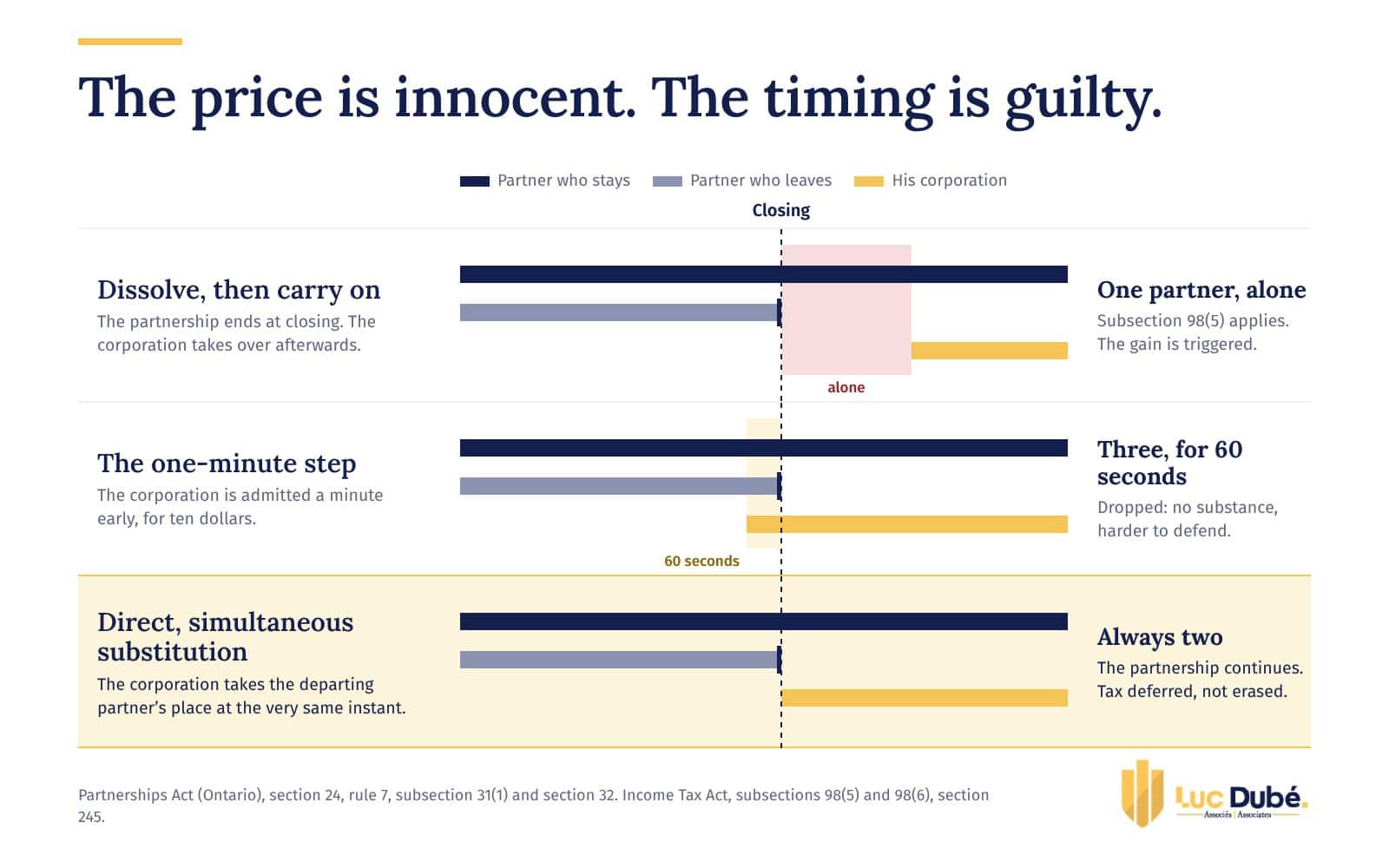
The solution we retained is almost dull. Graham’s corporation acquires Trevor’s interest directly, at the very moment Trevor withdraws. One partner out, one partner in, in a single stroke. There were two partners before closing and there are two after: Graham and his company. The firm name, the business number, the bank accounts and the employees all stay put. The partnership never ceases to exist, and subsection 98(5) has nothing to bite on.
The term sheet hardly changes. The corporation gives Trevor the indemnity he negotiated for the partnership’s debts, and Graham guarantees it personally. One caution travels with the structure. If the corporation is treated as a specified member, a negative cost base at the end of a fiscal period becomes an immediate gain under subsection 40(3.1) of the Income Tax Act. No distribution may push its cost base below zero.
This is where the common law does the heavy lifting, and where the legal professionals earn their keep. Rule 7 of section 24 of the Partnerships Act provides that « No person may be introduced as a partner without the consent of all existing partners. » Without that consent, subsection 31(1) leaves an assignee with a share of the profits and no seat at the table. And section 32, which lists the grounds of dissolution, opens with seven words that carry the whole plan: « Subject to any agreement between the partners ».
Hence four clauses in the closing documents. Consent: both partners agree that the corporation becomes a partner in Trevor’s place. Simultaneity: the assignment, the admission and the withdrawal take effect at one and the same instant, and none operates without the others. Continuation: the partnership is not dissolved, it carries on under the same name, and Graham never holds every interest. And a written agreement between Graham and his corporation, signed for that very moment, setting out how the business is run in common, how profits are shared and a December 31 year-end.
One drafting rule sits on top of the four. The words « dissolve », « terminate » and « new partnership » appear nowhere in the documents. In this corner of the law, vocabulary creates facts.
Why we threw out the clever plan
The first draft was smarter. Admit the corporation one minute before Trevor leaves, for ten dollars, so that three partners coexist for sixty seconds.
We dropped it, at the suggestion of Graham’s lawyer, and I am glad we did. Sixty seconds of membership carry no economic content. In Backman v. Canada, 2001 SCC 10, the Supreme Court of Canada went looking for a business truly carried on in common with a view to profit, whatever the paperwork said, and the Canada Revenue Agency’s Folio S4-F16-C1 follows that line: the ingredients of a partnership must be present from the moment of entry. Trevor would have had to consent to a third partner and to a stopwatch. Above all, the plan added a step with no commercial purpose, one more thing to defend under the general anti-avoidance rule in section 245 of the Income Tax Act.
On that rule, let’s call a spade a spade. For transactions on or after January 1, 2024, a transaction that produces a tax benefit is an avoidance transaction unless it may reasonably be considered that obtaining the benefit « is not one of the main purposes » for undertaking it. Ours probably qualifies. Abuse is another matter. The partnership truly continues, with a real second partner, a written agreement and the existing business. The corporation acquires a genuine interest, gives the indemnity and bears its share of profits and losses. Nothing is erased: the negative cost base stays attached to Graham’s interest, and the tax will fall due the day he disposes of it or the day the partnership ends. Deferred, then, and never forgiven.
Granted, should the rule apply to an undisclosed transaction, subsection 245(5.1) adds a penalty built on 25 per cent of the additional tax, and the reassessment period runs three years longer. An optional disclosure under subsection 237.3(12.1) removes both. It can be filed up to the filing-due date for the year of the transaction, with one more year of grace under subsection 237.3(12.2); settling the question before closing is prudence, not obligation. In my reading, the risk is low, on one condition: that the negative cost base is never made to disappear tax-free later on.
The simplest plan defends itself better than the cleverest one.
What nobody says out loud at closing
Three items rarely make it onto the agenda.
The first is the harmonized sales tax. The assignment of a partnership interest is an exempt supply of a financial service under the Excise Tax Act. The vehicles handed to the departing partner are not: under subsection 272.1(4) of that Act, the partnership is treated as having supplied them at fair market value. Someone absorbs that tax, and the choice belongs in the agreement, in writing. Subsection 98(2) of the Income Tax Act applies the same fair market value to those vehicles for income tax.
The second is the past. Subsection 18(2) of the Partnerships Act is blunt: « A partner who retires from a firm does not thereby cease to be liable for partnership debts or obligations incurred before the partner’s retirement. » He walks away from the business, not from its history. That explains the indemnity he asked for, and its limit: it gives him a claim against the corporation and Graham, and it binds no creditor, the Canada Revenue Agency least of all. It also explains why notice matters: under subsection 36(1), a person dealing with the firm may treat him as a member until notified of the change, and the business name registration has to be amended within 15 days. With a corporation among its members, the partnership also has a T5013 information return to file.
The third is confidentiality, and it is the one that surprises people. The reportable transaction rules in section 237.3 of the Income Tax Act treat certain confidentiality protections as a hallmark. The clause in the term sheet binds the two partners, not an adviser, so it does not count. The standard terms of a tax adviser’s engagement, which may restrict what the client can reveal, are a different animal. The cure costs one page: a letter, before closing, confirming that nothing prevents the client from disclosing the tax treatment or the structure to anyone, the Canada Revenue Agency included.
One more thing, since we are speaking plainly. What a tax adviser writes to a client is not protected by solicitor-client privilege, and storing that paper in a lawyer’s cabinet does not change its nature. Privilege attaches to confidential communications made to obtain legal advice. One more reason to bring the lawyer in at the start, and to let the legal advice come from the lawyer.
Decide who buys. Then sign.
There is no second attempt. In Canada (Attorney General) v. Collins Family Trust, 2022 SCC 26, the country’s top court refused to rescind transactions merely because they had produced a tax bill nobody saw coming. Six years earlier, in Canada (Attorney General) v. Fairmont Hotels Inc., 2016 SCC 56, it had shut the door on rectification as a cure for a plan that misfired. A document that fails to record the real agreement can still be corrected. A plan that was badly conceived stays that way.
So the question to settle before the term sheet is deceptively small. Who is buying: you, or your company? In this file, the answer was worth six figures, and nobody around the table had asked.
Graham keeps his business, his crews and his five-in-the-morning starts. Trevor goes home with his vehicles and his indemnity. The Crown will collect its tax, later, when the interest finally changes hands. Nothing was hidden, nobody was cheated, and payroll went out on time.
A partner who takes advantage of you is a nuisance. The provision you never read sends the invoice.
Buy him out. Just never be alone when he leaves.
At Luc Dubé & Associés, every mandate starts with a written analysis of your file, before anything is signed. www.lucdube.com
General information, current as of November 26, 2026. Graham and Trevor are composite characters, and the figures are illustrative. This column is not legal or tax advice for any particular situation; statutes and administrative positions may change.