
Thailand’s property market runs on a number the law itself declares sufficient, prices no buyer can verify, and a foreigner who is told he is the dishonest one.
Luc Dubé M.Tax – Tax Nomad®
It happens at a counter, in a government office, with a queue behind you and a ceiling fan that does not help. You hand over the money. Somebody types a number into a form. And the number they type is not the one you paid with.
In most countries that would be fraud. In Thailand it is the statute.
Section 104 of the Land Code, as amended in 1991 and retouched in 2000, never asks what you paid. It directs that the registration fee be calculated on the appraised capital value: a figure fixed by the Land Code’s own valuation committee and administered through the Treasury Department’s Property Valuation Division, revised roughly every four years, currently running on a 2023-2026 cycle that was itself postponed from 2020 and expires within months. According to Thai valuation practitioners, the appraised figure is 30 to 40 percent below what the property actually trades for. One Bangkok firm tells its own clients the assessed number is « normally one-tenth or less than the actual price you are paying to the seller ».
A nuance the industry rarely volunteers, and it matters. For specific business tax and stamp duty, the Land Office applies the higher of the appraised value or the price declared by the parties. Sounds like a safeguard. It is not one, for a simple reason: the comparison runs against the price the parties say, never the price they paid. The Land Office has no means of discovering the real consideration and no mandate to look for it. The appraised value functions as a floor. Declare anything at or above it, and the file goes through. In practice, the floor is where everybody stands.
The transfer fee itself, two percent, the largest line on the day, is calculated on the appraised value alone. No comparison. No test. No discretion. (A temporary concession trims it to 0.01 percent for Thai individual buyers of homes under seven million baht, through mid-2027. For everyone else, nothing changes.)
So the buyer pays less. The seller pays less on the gain. The clerk processes the file. Everybody in the room understands exactly what has happened, and nothing about it is furtive, because it is not an exception. This is the procedure, and the procedure has a statute behind it.
Hold that image. Everything else follows from it.
If the sovereign register of who owns what in Thailand records a number nobody paid, then the country’s entire price history rests on a legally sanctioned fiction. A market where nobody can prove what anything is worth is not a broken market. It is a sorting machine. It sorts the people who know from the people who pay.
The scaffolding that was never built
A buyer arriving from Toronto, Sydney or London carries an invisible scaffolding he has never once had to think about, because it has always simply been there. Take it apart, piece by piece.
Start with the listing system. There is none: no MLS, no shared database, no authoritative record of what is on the market. The clearest confirmation comes from the Bangkok agent who owns the ThaiMLS domain itself, Mark Prado, who bought it years ago and never built it: « Many professional real estate agents have discussed the potential, but there is still no Thai MLS which I am aware of. » Listings move through informal co-agent arrangements, one agent telephoning another. A condominium in Sukhumvit will surface on eleven agency websites at seven prices, with four different floor areas, some for a unit that sold eighteen months ago and was never taken down. Your first task as a buyer is to guess which of the seven prices is real. You have nothing to guess with.
Next, the sold-price record, and this needs stating precisely, because the absolutes get thrown around and the absolutes are wrong. Thailand does publish aggregates. The Real Estate Information Center reports transfer volumes and combined values quarterly: 72,583 residential units nationwide in the first quarter of 2026, up 11.2 percent year on year, worth 187.18 billion baht, up only 3.1 percent. The Bank of Thailand maintains a residential price index. What does not exist, anywhere, at any price, is the thing a buyer actually needs: what the unit next door sold for. No equivalent of the UK Land Registry’s Price Paid Data. No county record. Nothing at the address level.
The sting sits one layer deeper. Those national aggregates are compiled from registered values, and the registered values are the floor-hugging fictions described above. Thailand’s official property statistics are a careful, professional, quarterly measurement of a number the law permits to be false. The REIC has conceded a further point to the Bangkok Post: the Land Office does not distinguish between new and second-hand units. Hence, resale estimates rest on assumption rather than transaction data, and the agency runs on five analysts when it says it needs ten.
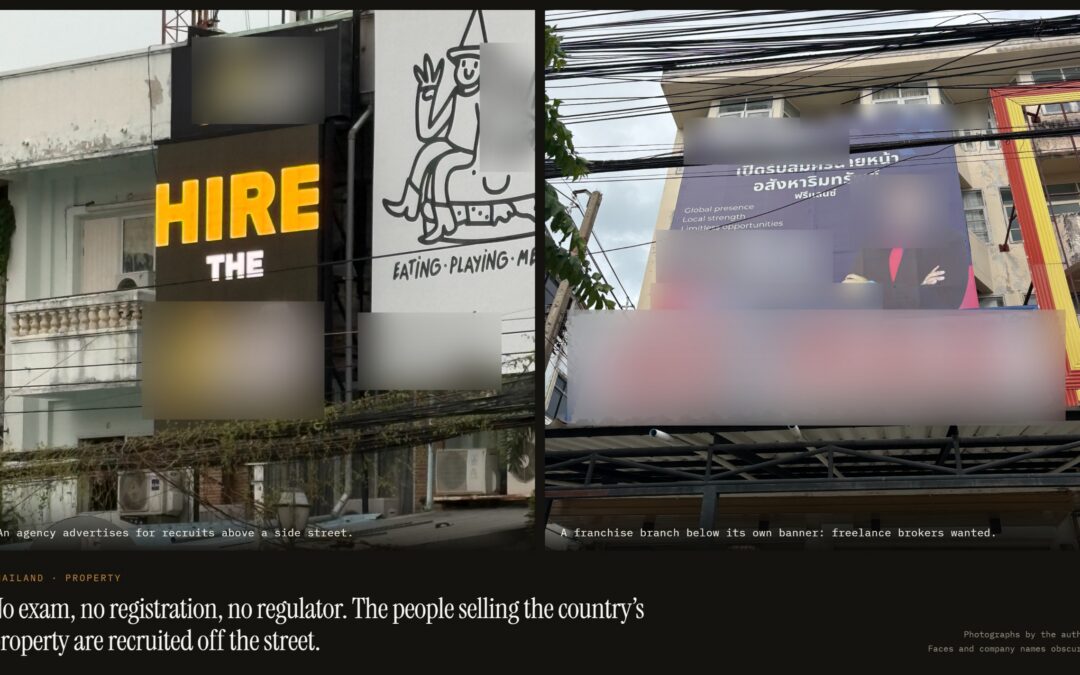
Consider the person across the table. Thailand has no personal license for real estate agents: no pre-licensing course, no examination, no license to lose, no regulator of conduct. To be exact, because the distinction will be thrown at anyone who overstates it: a brokerage firm registers with the Department of Business Development like any company, and brokerage is a restricted activity for foreigners under the Foreign Business Act. That is corporate paperwork. The individual putting a contract in front of you has passed nothing and answers to nobody. The Thai Real Estate Broker Association exists; membership is voluntary. No fiduciary duty to the buyer, no binding code of conduct, and a commission paid by the seller, out of the price.
Your money fares no better. Thailand passed an Escrow Act in 2008. According to Thai property counsel, such arrangements have « never become standard practice in the Thai property market », the Act « does not require buyers and sellers to use escrow », and, the operative point, « Thai law does not give a purchaser the right to require a property developer to use escrow ». Consumer-contract rules were tightened in early 2025, and some developers now voluntarily offer escrow as a selling point. The legal position has not moved: you cannot insist. You can only decline to buy. Why developers refuse is stated openly in the legal literature: purchaser deposits form part of the financing used to construct the project. Your down payment is not held for you. Once it crosses, the funds « generally become part of the developer’s working capital and are no longer under the purchaser’s control ».
Your title, meanwhile. Title insurance, routine in North American conveyancing, barely exists here: available in principle, as the Chambers guide to Thai real estate concedes, but « not common », confined to large commercial deals, with no retail market to speak of. The residential buyer gets a substitute: a lawyer-conducted search at the Land Office, a professional opinion at a point in time, not an indemnity. Wrong deed class, generous survey, a prior claim surfacing: no insurer makes you whole. What you get is a lawsuit, in a language you do not read, in a system whose record on land disputes we will come to.
Last, the valuation. Two numbers exist. The Treasury’s appraised value, up to four years stale and structurally below market. The bank’s internal appraisal, produced by the bank, for the bank. Anyone with a duty to the person paying produces no third figure.
No listing system, no sold prices, no license, no escrow, no title insurance, no independent valuation: strip all of it away and ask what remains of a property transaction. What remains is a stranger telling you a number, and you deciding whether to believe him.
The scams are not scams.
Take each of the frauds foreigners in Thailand lose their savings to and ask which missing safeguard makes it possible. The answer is never « a criminal ».
The off-plan project that never finishes. The buyer pays a deposit, then construction-stage installments, on a building that exists as a rendering. The money goes straight to the developer because no law requires otherwise. Construction stalls. The buyer then discovers his position: limited remedies, possibly the rank of an unsecured creditor, behind the banks, behind the contractors, behind the tax authority, in a queue for money spent years ago on a different project. In a jurisdiction with mandatory escrow, this failure is arithmetically impossible. Thailand enacted an escrow law and made it optional, which, for the buyer, amounts to not including it.
The guaranteed rental return. Ten percent a year, guaranteed, for ten or fifteen years, printed on glossy paper. Set that against the market: Phuket’s mainstream developers offer five to seven percent over two to five years, and analysts treat anything above seven percent as a warning that either the developer is carrying unsustainable risk or the guarantee has been priced into an inflated purchase price, which is the elegance of the structure. The investor is frequently paid his own money back slowly and told it is yield.
Desmond Hughes of Hughes Krupica in Phuket put the counterparty problem plainly: if the guarantee comes from « a company with small paid-up capital, directors who are not overly concerned about commercial risk and a short history of operations », then « the guarantee will have little substance ».
Now ask how often these schemes actually fail. Nobody can tell you. Hughes again, on his own market: « there is no centralized reporting system in place to prepare accurate property sales information in Phuket ». In fairness, practitioners reported that most guarantees were honored under normal conditions. But « reported » is the whole point. A product sold to thousands of foreigners has a failure rate nobody has ever measured. The missing data layer conceals the size of its own damage.
The ninety-year lease. For two decades, foreigners who cannot own land were sold 30+30+30: a thirty-year registered lease with two pre-agreed renewals stapled on, marketed as ninety years and effectively freehold, drafted by qualified Thai lawyers.
In Decision 4655/2566, decided in 2023 and published in March 2025, which is why half the internet has the date wrong, the Supreme Court held that renewals signed on the same day as the original lease, as a device to get around the thirty-year cap in Section 540 of the Civil and Commercial Code, are void. The lessee was ordered out and told to pay damages.
The law firms sold this as a bombshell. It was nothing of the kind, and that is the real story. Thai courts have said the same thing for six decades: a renewal promise is a personal undertaking, not a property right, and it does not bind a successor in title. Decision 1170/2506 said it in 1963. Decision 5277/2540 said it in 1997. Decision 6763/2541 confirmed that his predecessor’s promise does not bind a new owner. Section 540 has always read: « The duration of a hire of immovable property cannot exceed thirty years. »
So the ninety-year lease was never a grey zone. It was a house of cards the profession sold anyway, with government registration in writing for 20 years, to thousands of villa buyers in Phuket and Koh Samui. Not a loophole that closed. A misrepresentation that finally got tested.
The nominee company. The most respectable of all. A foreigner forms a Thai company in which Thai nationals hold the majority, and he holds control. Bangkok firms with English websites sold it as the compliant route. The registrar registered the companies. The Land Department transferred the titles—fees collected at every step, for twenty years.
And this is where the hypocrisy cuts deeper than the usual telling. The state was not asleep. On 15 May 2006, the Ministry of Interior issued a « Very Urgent » directive requiring land offices to examine Thai companies with foreign shareholders before permitting land acquisition; a second followed on 21 July 2006. Both confirmed that companies holding land for foreigners without genuine Thai investment were not lawful Thai entities and could not own land. In 2008 the DBD introduced procedures to identify nominee structures. In 2022 came a public warning from the Commerce Ministry and a Land Department circular.
Warned in 2006. Warned again in 2008 and warned again in 2022. And the companies were registered, the titles transferred, and the fees collected regardless until October 2025, when an AI-driven screening system began cross-referencing the corporate registry with other government databases in real time to flag nominee indicators.
The Department of Business Development identified 46,918 at-risk companies, every entity with foreign shareholding between 0.001 and 49.99 percent, with the heaviest concentrations in Chachoengsao, Bangkok, Surat Thani and Phuket. Roughly 875 prosecutions have followed, with claimed damages above 15 billion baht. By June 2026, the at-risk pool had been restated at 119,297 companies. The Revenue Department auditing 14,800 of them, the Land Department reviewing 17,556 holdings, the DSI filing over 2,200 cases, thirty-five field operations across eleven provinces, a twenty-three-agency enforcement pact signed in April 2026: the machinery of a state that has decided to move.
Under Section 94 of the Land Code, unlawfully acquired land « shall be disposed of by such alien within the time limit prescribed by the Director-General which shall not be less than one hundred eighty days nor more than one year », with Section 96 extending the rule to nominee holdings and a May 2026 circular directing forced disposal, normally by public auction. A further amendment, acknowledged by Cabinet in February 2026 and still only under study, would strip the foreigner of the proceeds entirely and vest the land in the State.
Read the sequence once more. The state warned that the structure was unlawful. The state registered it anyway. The state collected the fees. Then the state built an AI to find it, and moved to take the asset. From the buyer. Never from the law firm that drafted it and kept the fee. Never from the officials who stamped it knowing what the 2006 directives said.
Four frauds. Not one required a criminal. Each required only an absence, and, in the last case, an official who chose not to look.
A market that refuses to price
The missing verification layer explains how buyers are taken advantage of. It also explains something stranger: why a market this oversupplied took so long to fall.
Knight Frank Thailand put Greater Bangkok’s unsold condominium overhang at roughly 350,000 units in June 2026, equivalent to five to six years of supply at current absorption rates. Read that number with care, because it is contested: SCB EIC, measuring accumulated unsold inventory across all residential types, projects 213,000 units by end-2026—a dispute of method, not of direction.
Across the first three months of 2026, developers launched 6,174 condominium units and not one new project in the central business district. The booking rate on new launches fell from 43.8 percent in the previous quarter to 24.3 percent: fewer than one unit reserved for every four offered. Sixty-eight percent of launches came in below 80,000 baht per square meter, with developers retreating into the mass market because the higher end stopped responding.
Now look at what prices did. The Bank of Thailand’s residential index rose 1.26 percent nationally, year on year, over that same quarter. Bangkok and its surrounding provinces slipped 0.18 percent, the only region in the country to decline. Honesty requires a detail that complicates the story: within that region, condominiums actually rose 1.95 percent, and detached houses drove the decline, down 1.59 percent.
How does a market carry nearly six years of unsold stock without the price moving? Colliers named the mechanism: developers « generally sought to preserve headline prices through incentives and promotional packages rather than outright reductions ». Free furniture, transfer fees paid, years of common charges waived, a car in one case: the buyer pockets a real discount of ten or fifteen percent, and the number entering the record, the index, and the next buyer’s comparable stay exactly where they were.
The counter scene again, at industrial scale. A visible price cut would be a confession. It would reprice every comparable unit in the building, every building in the district, every mortgage held against them.
But the discipline is now cracking, and that is the most interesting development in the Thai market this year. By July 2026, the discounting had surfaced in the open: new homes cut by ten to thirty percent on average, a four-million-baht provincial house marked down by a million, second-hand condominium prices in some areas down 8.3 percent in a single year. JLL recorded outright discounts in Thonglor and Phrom Phong and capital values down 1.3 percent on the quarter.
The transfer data tells the same story in a quieter register: volumes up 11.2 percent, values up 3.1 percent. More units, cheaper units. The fiction held exactly as long as the sellers could afford it.
Who holds the map
Opacity is never neutral. Somebody always holds the map.
On 1 May 2025,, the Criminal Court for Corruption and Misconduct Cases, Region 3, sitting in Surin, convicted Prayudh Mahagitsiri, a coffee and steel magnate and the eighteenth on Forbes’s list of Thailand’s richest, and sentenced him to 24 years on six counts. His daughter Ausana received twelve years. A former land officer received 42 years, and an acting head of survey 30. The court found that re-surveying had enlarged the plot by 189 rai into protected forest reserve and land-reform territory, bringing the Mountain Creek golf resort to 2,304 rai. Sor Por Kor land, under the Agricultural Land Reform Act of 1975, is allocated to poor and landless farmers, capped at fifty rai each, for farming use only. A golf course for the very rich, on soil the law reserves for the very poor. These are first-instance convictions: all defendants are free on one million baht bail, barred from leaving the country, and appealing. No appellate ruling has been reported.
At Khao Kradong in Buri Ram, 5,083 rai are reserved for the State Railway of Thailand by a 1919 royal decree that established the northeastern railway alignment. A series of Supreme Court rulings between 2014 and 2018 found for the railway; the Appeal Court Region 3 concurred; each ruling bound only the parcels litigated. In 2023, the Central Administrative Court ordered the Department of Lands to convene a Section 61 committee to consider revoking the deeds, while a later administrative ruling declined to order revocation directly. In August 2025, the Interior Ministry, then under the Pheu Thai-led government, declared the land state property and directed the Director-General to proceed.
What has happened since is the whole point. By June 2026, the Department of Lands had revoked four documents affecting 35 holders who were bound by final judgments. It refused to touch the remaining 995 plots, because the railway’s evidence was not clear enough to establish which areas it owned. The railway’s challenge to that refusal is pending. Separate litigation over 108 plots grinds on in the Buri Ram provincial court. In March 2026, the Department of Special Investigation closed a seven-month probe and passed the criminal file to the anti-corruption commission.
On that land sit the Chang Arena stadium and the Chang International Circuit. Land records show the stadium is on a deed held by Chaichanok Chidchob and leased to a family company, with additional plots held by Newin Chidchob’s wife, Karuna, and an associated firm. Newin founded Bhumjaithai in 2008 and leads it without holding office. Chaichanok is the party’s secretary-general and Minister of Digital Economy and Society in the current cabinet.
Prime Minister Anutin Charnvirakul, Bhumjaithai’s formal leader, in office since September 2025 and returned by parliament in March 2026 after February’s election, gave his party the largest bloc, is himself the heir to Sino-Thai Engineering and Construction, the firm his father founded in 1962 and which built Thailand’s new parliament complex; family vehicles hold around twenty percent. He faces ethics complaints over the failure to enforce the Khao Kradong rulings, filed with the anti-corruption commission and the Election Commission in May 2026 after the opposition could not gather enough MP signatures to petition the Constitutional Court directly. None has been accepted for formal proceedings. The House Speaker, who decides whether such petitions advance, is a Bhumjaithai MP from Buri Ram.
And on 17 January 2024, the Constitutional Court ruled seven to one that Saksayam Chidchob, then transport minister and Newin’s brother, had retained beneficial ownership of Buri Charoen Construction Limited Partnership through a nominee while it won more than a billion baht in contracts from his own ministry, and retroactively terminated his ministerial status.
Then the sequel. On 8 September 2025, the National Anti-Corruption Commission quietly resolved that there had been no deliberate concealment, accepting that Saksayam believed the shares had been lawfully transferred before he took office. The resolution surfaced only in March 2026, after the commission’s secretary-general first denied any conclusion existed, and was defended in a formal statement that April. A body that answers to the courts had contradicted the court that outranks it.
Vicha Mahakhun, a former commissioner of that same agency, said the necessary thing in public: « The NACC is not a court. » Independent bodies, he added, are not independent in mid-air. As the Bangkok Post relayed his criticism, the commission exists to investigate and forward cases to the courts, not to contradict their rulings.
The arithmetic of hypocrisy
Set the two enforcement records side by side. Not as a percentage; the honest comparison is simpler, and worse.
Against foreigners: an AI screening system, 46,918 companies on an at-risk register and later 119,297, roughly 875 prosecutions, 17,556 holdings reviewed, raids in eleven provinces, a pact binding twenty-three agencies, forced disposal under Section 94 and a proposal to confiscate outright.
Against 5,083 rai of state railway land occupied by the governing party’s founding family, after a decade of court rulings, an administrative order and a ministerial directive: 35 title holders stripped, 995 plots refused, and not one square meter under the stadium or the circuit disturbed.
The machinery exists. It moves with extraordinary speed and reach when pointed at foreigners, and finds the evidence insufficiently clear when pointed at Buri Ram.
And note what the foreigner is actually accused of. Using a structure the state warned about in 2006 and then registered for him for twenty years. He is not accused of what happens at every Land Office counter in the country, because the law does not require the truth there. Section 104 asks for the appraised value, and that’s what it gets.
The hypocrisy fits in one line. Thailand demands honesty from the foreigner inside a registry its own statute permits to be fictional.
You were never the customer.
If you are buying property in Thailand, understand what you are being asked to do. Pay a price you cannot verify, for an asset whose registered value is a legal floor rather than a fact, on advice from an unlicensed agent who owes you nothing, with money you cannot protect, on a title virtually no insurer will stand behind, in a market whose price signal has been buried under promotional packages. And accept, if it goes wrong, that this country’s courts can rule on a piece of land for ten years while 995 plots stay exactly where they are.
You are not being offered a bad deal. You are being offered a coin flip described as a deal.
And if you are a Thai family, none of this was built for you either. Roughly four in ten mortgage applications are refused outright; below three million baht, where most Thai families actually buy, rejection reached seventy percent in late 2025, an unprecedented high. Household debt stands near 87 percent of GDP, down from a peak above 95 percent in 2021, with non-performing household loans at 9.59 percent and climbing. Growth ran at 2.8 percent in the opening quarter of 2026, then at 1.9 percent in the second quarter. And 350,000 empty condominiums wait for a price nobody will print.
The foreigner is not the reason the market is a game for dupes. He is the reason nobody is looking at the table.
No MLS, because a market with an MLS can be checked. No sold-price record, because a market with sold prices can be valued. No licensed agents, because licensed agents can be struck off. No mandatory escrow, because escrow removes a free line of credit. Title insurance is a rarity, because insurers price risk, and pricing risk requires data.
None of that is under development. Thailand builds airports and parliaments, runs a competitive banking sector, operates one of the world’s great tourism machines. A country that can do those things can build a listing database, and can write a statute that asks for the real price. It has not. The men who would have to approve it are the men who profit from the dark.
The price on the deed is a lie the law permits. Every other lie in Thai real estate is downstream of that one.